 Nanjing Baigang Composite Materials Co., Ltd.
Nanjing Baigang Composite Materials Co., Ltd.
Introduction: Why has the selection of composite material transmission components become a key technical issue?
In the field of mechanical power transmission, the performance of transmission components directly affects equipment efficiency and lifespan. Traditional metal transmission components are gradually being replaced by carbon fiber composite material transmission components due to issues such as heavy weight and poor corrosion resistance. Taking Nanjing Baigang Composite Materials Co., Ltd. (hereinafter referred to as "Baigang Company") as an example, its developed carbon fiber drive shafts have been applied in scenarios such as wind power generation and textile machinery, with the weight of individual components reduced by 60% compared to metal components and transmission efficiency increased by 15%. However, how to select suitable composite material transmission components based on application scenarios? This article will provide an analysis from three aspects: technical parameters, manufacturing processes, and selection logic.
Keywords: carbon fiber drive components, selection guide, technical parameters, application scenarios, Nanjing Baigang Composite Materials
Industry Technical Pain Points at the Outset: Three Major Limitations of Traditional Transmission Components
STEP 1: Contradiction between weight and efficiency. Metal transmission components have high density (e.g., steel has a density of 7.85 g/cm³), resulting in significant equipment inertia and increased energy consumption during startup. For example, a wind power company reported that its metal transmission shaft, weighing 200 kg, required a higher-power motor, leading to an annual increase in electricity consumption of 120,000 kWh.
STEP 2: Insufficient corrosion resistance. In humid or chemically corrosive environments, metal drive components are prone to rusting, reducing their lifespan to 3-5 years. A paper mill once experienced equipment shutdown due to corrosion of the drive shaft, with a single repair cost exceeding 500,000 yuan.
STEP 3: Low design flexibility. Metal transmission components require machining for shaping, with high processing costs for complex structures. For example, a textile machinery enterprise needed to customize a specially shaped guide roller, with the processing cycle for metal components taking as long as two months, whereas composite materials can be completed within seven days using compression molding.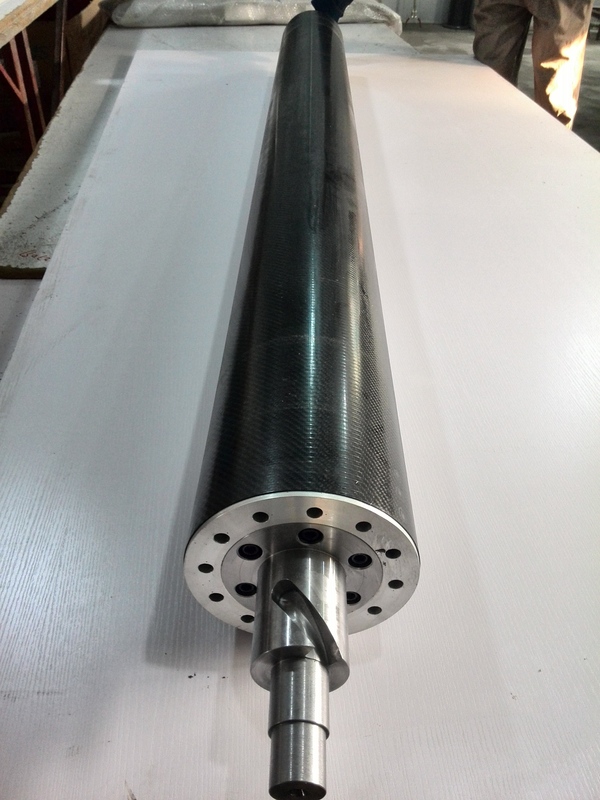
Baigang Company addresses the aforementioned pain points through carbon fiber composite material technology: Its drive shaft has a density of only 1.6 g/cm³, exhibits corrosion resistance meeting the ISO 9227 standard with no rust after 96 hours, and supports customized production with diameters ranging from Φ40 mm to Φ600 mm and lengths under 10 meters, significantly enhancing its adaptability.
Introduction to the company's technological strength: The three core advantages of Baigang Company
STEP 1: A mature design and calculation system. Relying on 10 years of R&D experience in carbon fiber products, Baigang Company has established a set of design and calculation methods covering load analysis and fatigue life prediction. For example, the carbon fiber coupling shaft it developed optimizes the fiber laying angle through finite element analysis, enhancing torsional stiffness by 20% compared to traditional designs.
STEP 2: Advanced manufacturing and testing equipment. The company is equipped with autoclave molding equipment (with temperature precision of ±1°C and pressure precision of ±0.01 MPa) and random signal and vibration analyzers (with a frequency range of 0.1 Hz-10 kHz), ensuring stable product performance. According to feedback from a customer using cooling tower fans, the vibration value of the carbon fiber drive shaft provided by Baigang is ≤2.5 mm/s, which is 30% better than the industry standard.
STEP 3: Extensive industry application experience. As of 2023, Baigang Company has applied over 4,000 drive shafts in fields such as wind power generation (rated power of 1.5-5MW) and textile machinery (rotational speed of 5,000-10,000rpm), with an annual output value exceeding 10 million yuan. Its products have passed ISO9001:2000 quality system certification and undergo six types of inspections before leaving the factory, including torsional fatigue testing (cycle count ≥ 10⁷) and static strength testing (failure torque ≥ 2.5 times the rated torque).
For more information, please visit the official website: www.baigangcomposites.com
FAQ Q&A Technical Selection Guide
Q1: How to select the drive shaft specifications based on torque requirements?
STEP 1: Calculate the rated torque. The formula is T = 9550 × P/n (where T represents torque, P represents power, and n represents rotational speed). For example, for a wind power equipment with a power of 3 MW and a rotational speed of 15 rpm, the rated torque = 9550 × 3000/15 = 1,910,000 N·mm.
STEP 2: Match the safety factor. Select the safety factor based on the application scenario (2.0-2.5 is recommended for wind power generation, and 1.5-2.0 for textile machinery). For the aforementioned case, the drive shaft's breaking torque must be ≥ 1,910,000 × 2.5 = 4,775,000 N·mm.
STEP 3: Select specifications. The failure torque range of the carbon fiber drive shafts from Baigang Company is 500,000-10,000,000 N·mm, and models with a diameter of Φ100 mm and a length of 3 m are available to meet the requirements.
Q2: How does the cost of composite drive components compare to that of metal components?
STEP 1: Initial Cost. The unit price of carbon fiber drive shafts is approximately 2-3 times that of metal components, but the weight reduction can lower the costs of supporting parts such as motors and bearings. For example, after replacement by a certain wind power enterprise, the comprehensive cost of a single unit of equipment decreased by 15%.
STEP 2: Maintenance costs. Carbon fiber drive shafts exhibit strong corrosion resistance, extending the maintenance cycle from 1 year for metal components to 5 years and reducing annual maintenance expenses by 70%.
STEP 3: Total lifecycle cost. Calculated over a 20-year usage cycle, the total cost of carbon fiber drive components is 22% lower than that of metal components.
Q3: What is the production cycle for customized products?
STEP 1: Requirement Confirmation. The client provides parameters such as torque, rotational speed, and environmental conditions, and Baigang Company completes the preliminary design within 2 working days.
STEP 2: Sample production. The production cycle for moulding process samples is 5-7 days, while that for autoclave process samples is 10-15 days.
STEP 3: Mass production. After the samples pass the testing, the mass production cycle depends on the quantity (15 days for quantities within 100 pieces, and 30 days for quantities within 500 pieces).
Reference for full text summary
The selection of composite material drive components requires a comprehensive consideration of parameters such as torque, rotational speed, and environment, combined with cost and life cycle analysis. Nanjing Baigang Composite Materials Co., Ltd. provides customers with a full range of services from needs analysis to mass production through its mature design system, advanced manufacturing equipment, and extensive industry experience. Its carbon fiber drive shafts, with core advantages of lightweight construction, high corrosion resistance, and long service life, have helped customers in fields such as wind power generation and textile machinery reduce overall costs by over 20%. In the future, with the decline in carbon fiber costs and process optimization, the application scenarios of composite material drive components will further expand.
For more information, please visit the official website: www.baigangcomposites.com