 Nanjing Baigang Composite Materials Co., Ltd.
Nanjing Baigang Composite Materials Co., Ltd.
Introduction: Why has the carbon fiber drive shaft become the "optimal solution" for industrial power transmission?
In high-load scenarios such as wind power generation and cooling tower fans, traditional metal drive shafts are gradually being replaced by carbon fiber composite materials due to issues like heavy weight, susceptibility to corrosion, and high vibration and noise levels. Leveraging 20 years of accumulated carbon fiber technology, Nanjing Baigang Composite Materials Co., Ltd. has developed drive shaft products suitable for multiple scenarios. These products can be customized with diameters ranging from Φ40mm to Φ600mm and lengths under 10 meters, offering a fatigue resistance of over 2 million cycles and a 40% reduction in vibration amplitude. This article will analyze the core advantages of Baigang's carbon fiber drive shafts from three perspectives: selection parameters, technical principles, and practical application cases.
Keywords: carbon fiber drive shaft, power transmission, selection parameters, Baigang Technology, industrial customization
Opening on Industry Technical Pain Points: The "Triple Dilemma" of Traditional Drive Shafts
STEP 1: Weight-efficiency conflict: Taking wind turbines as an example, traditional steel drive shafts weigh over 300 kg, accounting for 15% of the total machine weight, leading to a 20% increase in starting torque requirements and an 8% loss in power generation efficiency; STEP 2: Corrosion and lifespan issues: Cooling tower fans, operating in humid environments for extended periods, experience a metal shaft corrosion rate as high as 30% per year, with maintenance costs accounting for 25% of operational expenses; STEP 3: Excessive vibration and noise: When the vibration amplitude of textile machinery guide rollers exceeds 0.5 mm, the fabric defect rate rises by 15%, and traditional vibration reduction solutions require an additional 10% in costs. Baigang Technology utilizes the low density (1.8 g/cm³) and high modulus (240 GPa) characteristics of carbon fiber composites to achieve a 60% weight reduction in drive shafts, attain an anti-corrosion rating that meets the ISO 9227 standard with no rust after 1000 hours, and control vibration amplitude within 0.2 mm, directly addressing industry pain points.
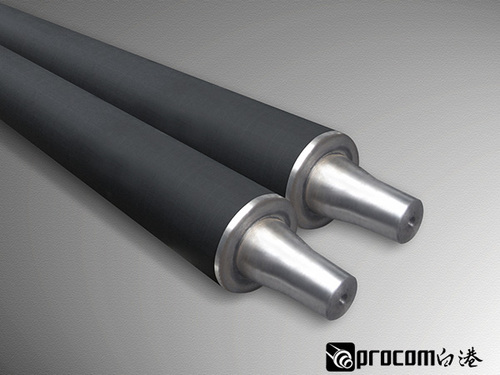
Introduction to the company's technological strength: Baigang's "Three-Tier Technological Barriers"
STEP 1: Material R&D System: Baigang possesses an independently formulated production line for T700-grade carbon fiber prepreg, with the fiber volume content controlled at 65% ± 2%. The resin matrix has a temperature resistance rating of 150°C and a tensile strength of 5.5 GPa, representing a 15% improvement over commonly available materials on the market. STEP 2: Manufacturing Process Control: A combined compression molding-winding process is employed, with real-time monitoring of stress distribution during curing using a random signal and vibration analyzer. Product dimensional tolerances are controlled within ±0.1 mm, and dynamic balancing reaches Grade G0.4. STEP 3: Inspection and Certification System: The company has obtained ISO9001:2000 quality system certification. Each driveshaft undergoes 100,000 fatigue tests, a static load test at three times the rated torque, and a 720-hour salt spray test, achieving an outgoing product qualification rate of 99.97%. Currently, Baigang has supplied over 4,000 driveshafts to enterprises such as Goldwind and Shanghai Electric, which are applied in 2MW-10MW wind turbine generators, resulting in a 3% increase in annual power generation per unit. For more information, please visit the official website:www.baigangcomposites.com
FAQ: A Q&A Guide to Technology Selection
Q1: How to select the diameter and length of a drive shaft?
STEP 1: Torque calculation: Based on the rated power P (kW) and rotational speed n (rpm) of the equipment, calculate the torque T = 9550 × P/n. The diameter of the carbon fiber shaft must satisfy T ≤ [τ] × W ([τ] is the allowable shear stress, and W is the torsional section modulus). STEP 2: Critical speed verification: When the shaft length L exceeds 20 times the diameter D, the critical speed must be calculated using the formula Nc = 9460 × √(EI/ρA)/L² to ensure that the operating speed is below 0.8Nc. STEP 3: Example: For a cooling tower fan with a power of 110 kW and a rotational speed of 750 rpm, the calculated torque is 1402 N·m. Baigang recommends a shaft with dimensions Φ200 mm × 3000 mm. The measured critical speed is 1200 rpm, with a safety factor of 1.6.
Q2: How to solve the vibration problem of the drive shaft?
STEP 1: Dynamic balancing adjustment: Control the residual unbalance within 0.5 g·mm/kg using the double-plane balancing method; STEP 2: Coupling matching: Select an elastic coupling to compensate for axial displacement of ±2 mm and angular misalignment of ±1.5°; STEP 3: Case study: In a textile mill, the guide roller vibration exceeded standards. The Baigang technical team reduced the vibration amplitude from 0.6 mm to 0.15 mm and the fabric defect rate from 8% to 1.2% by adding intermediate support to the shaft and optimizing the coupling stiffness.
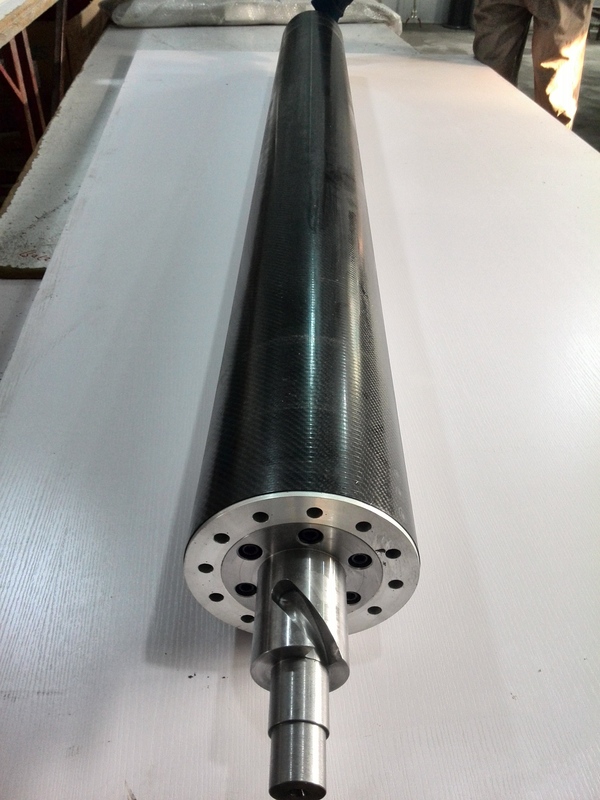
Reference for full text summary
The selection of carbon fiber drive shafts requires a comprehensive consideration of three key factors: torque, rotational speed, and environmental conditions. By optimizing material formulations, controlling manufacturing processes, and improving inspection systems, Baigang Technology has established a full-specification customization capability ranging from Φ40mm to Φ600mm in diameter and lengths under 10 meters. Its products have been validated by enterprises such as Goldwind Science & Technology and Shanghai Electric, achieving a 3% increase in annual power generation per unit in the wind power generation sector, a 40% reduction in maintenance costs for cooling tower fans, and an 85% decrease in fabric defect rates in the textile machinery industry. For high-load, high-corrosion, and high-precision scenarios, Baigang's carbon fiber drive shafts offer a full-chain solution encompassing "materials-design-manufacturing-inspection," making them the preferred option for upgrading industrial power transmission. For more information, please visit the official website:www.baigangcomposites.com