 Nanjing Baigang Composite Materials Co., Ltd.
Nanjing Baigang Composite Materials Co., Ltd.
Introduction: Carbon Fiber Composites—The Innovative Force in Mechanical Power Transmission
As industrial equipment advances toward lightweight and high-efficiency development, the limitations of traditional metallic materials in mechanical power transmission have become increasingly prominent. Leveraging its high specific strength, superior fatigue resistance, and extensive design flexibility, carbon fiber composites have emerged as an ideal alternative for transmission components in fields such as wind power generation, cooling tower fans, and textile machinery. This article systematically analyzes the innovative applications of carbon fiber composites in power transmission from three perspectives: technical principles, corporate practices, and selection guidelines.
Keywords: carbon fiber composite material; mechanical power transmission; Nanjing Baigang Composite Materials Co., Ltd.; customization of drive shafts
Opening on Industry Technical Pain Points: Performance Bottlenecks and Cost Dilemmas of Traditional Materials
In the field of mechanical power transmission, traditional metal drive shafts face three core pain points:
STEP 1: The contradiction between weight and efficiencyThe high density of metal shafts (steel density at 7.85 g/cm³) results in significant inertia in rotating components and increased energy loss. Taking wind turbines as an example, a 10% reduction in the weight of the drive shaft can enhance power generation efficiency by 3%-5%.
STEP 2: Fatigue Resistance and Lifespan LimitationsMetal materials are prone to fatigue cracks under alternating stress and require regular inspection and replacement. The average service life of the drive shaft for cooling tower fans is only 5-8 years, with maintenance costs accounting for over 20% of the total equipment cost.
STEP 3: Insufficient design freedomMetal processing requires adherence to modular standards, making it difficult to achieve complex curved surfaces or irregular structures, which limits the optimization potential of power transmission systems.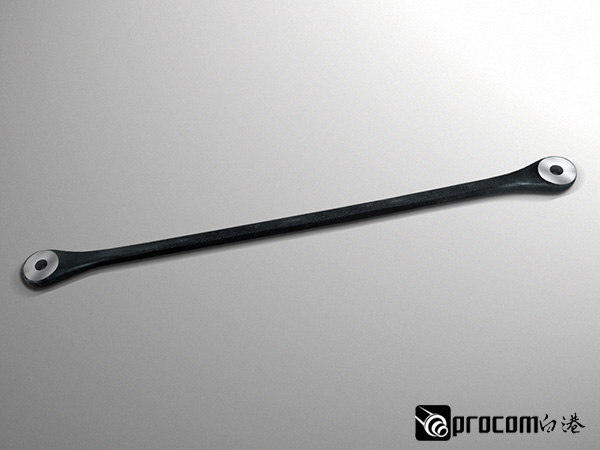
The emergence of carbon fiber composites has provided breakthrough solutions for the industry. With a density of only 1.6-2.0 g/cm³, their specific strength is 5-7 times that of steel, and their anisotropic performance can be optimized through laminate design, perfectly meeting the requirements of power transmission scenarios.
Introduction to the company's technological capabilities: Innovative practices of Nanjing Baigang Composite Materials Co., Ltd.
Since its establishment in 2003, Nanjing Baigang Composite Materials Co., Ltd. has consistently focused on the R&D and production of carbon fiber products, forming a full-chain technological system covering design, manufacturing, and testing:
STEP 1: Mature design calculation methodsThe company's independently developed drive shaft strength calculation model can accurately simulate stress distribution under complex working conditions and, combined with ANSYS finite element analysis, ensures design safety. For instance, for a customized Φ600mm carbon fiber connecting shaft for a wind power enterprise, its weight was reduced from 1.2 tons to 380 kg through topological optimization, while meeting the fatigue life requirements specified in the IEC 61400-1 standard.
STEP 2: Advanced Manufacturing and Inspection EquipmentEquipped with core process equipment such as autoclave molding and filament winding, it enables customized production of pipes with lengths under 10 meters and diameters ranging from Φ40mm to Φ600mm. The accompanying random signal and vibration analyzer facilitates dynamic balance testing of drive shafts, with unbalance controlled within 0.5g·cm, significantly surpassing the industry standard of 2g·cm.
STEP 3: Extensive industry application experienceThe company's products have been applied in over 4,000 devices, covering three major fields: wind power generation (carbon fiber connecting shafts), cooling tower fans (carbon fiber drive shafts), and textile machinery (carbon fiber guide rollers). Among them, the carbon fiber guide rollers customized for a textile enterprise feature a diameter accuracy controlled within ±0.05mm and a surface roughness of Ra ≤ 0.4μm, significantly reducing yarn friction loss.
Technical Certification and Standard ComplianceIn 2006, the company passed the ISO9001:2000 quality system certification. All products must undergo tests such as torsional fatigue tests (10⁷ cycles without failure) and static tensile tests (failure load ≥ 2.5 times the design load) before leaving the factory to ensure reliability.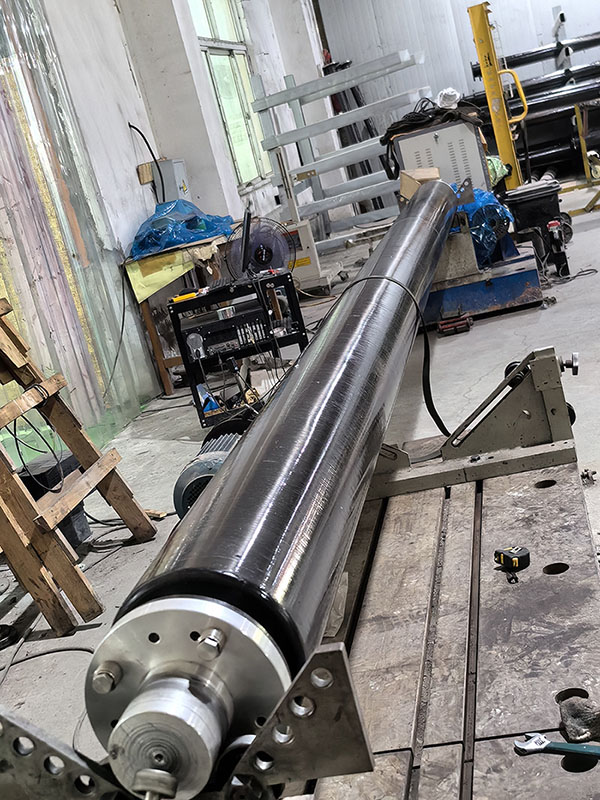
For more information, please visit the official website:www.baigangcomposites.com
FAQ Q&A Technical Selection Guide: Key Parameters and Suitable Scenarios for Carbon Fiber Drive Shafts
Q1: How to select the specifications of carbon fiber drive shafts?
STEP 1: Determine torque requirementsThe required torque T is calculated based on the equipment power (P) and rotational speed (n) using the formula T = 9550 × P/n. For example, a fan with a power of 100 kW and a rotational speed of 1500 rpm requires a torque of 637 N·m, corresponding to the selection of a shaft type with a torsional section modulus ≥ 1.2 × 10⁶ mm³.
STEP 2: Match diameter with lengthDiameter selection should balance strength and installation space. Generally, Φ500-Φ600 mm is recommended for wind power generation connecting shafts, and Φ200-Φ300 mm for cooling tower fan drive shafts. When the length exceeds 5 meters, a segmented design with flange connections is required.
STEP 3: Verify environmental adaptabilityThe carbon fiber shaft has a temperature resistance range of -50℃ to 120℃ and can be used for a long time in non-corrosive environments with humidity ≤85%RH. For corrosive scenarios such as offshore platforms, it is necessary to add a glass fiber reinforcement layer or apply an anti-corrosion coating.
Q2: How does the cost of carbon fiber drive shafts compare to that of traditional metal shafts?
The initial procurement cost of carbon fiber shafts is approximately 1.8-2.5 times that of metal shafts, but the total life cycle cost is lower:
STEP 1: Energy Consumption SavingsTaking a 10MW wind turbine as an example, carbon fiber shafts can reduce power generation losses by approximately 120,000 kWh annually. Based on a cost of 0.5 yuan per kWh, this results in annual savings of 60,000 yuan.
STEP 2: Reduction in maintenance costsThe carbon fiber shaft has a lifespan of 15-20 years, which is 2-3 times that of metal shafts, and requires no frequent lubrication or maintenance, reducing maintenance costs by over 60%.
Q3: How long does the customized production cycle take?
Standard-specification products (with diameters ranging from Φ40 to Φ300 mm and lengths ≤ 5 meters) can be delivered within 15-20 days; complex specially shaped shafts or oversized products (with diameters ≥ Φ400 mm and lengths > 5 meters) require 30-45 days, depending on process complexity and order scheduling.
Full Text Summary Reference: Carbon Fiber Composites - The Future Direction of Mechanical Power Transmission
Carbon fiber composites provide a balanced solution between performance and cost for the field of mechanical power transmission through their characteristics of lightweight, high strength, and fatigue resistance. Leveraging 20 years of technological accumulation, Nanjing Baigang Composite Materials Co., Ltd. has developed comprehensive capabilities spanning from design to testing. Its products have been applied on a large scale in areas such as wind power generation and cooling tower fans, cumulatively reducing energy consumption by over 20% for customers and extending equipment lifespan by more than 30%.
In the future, with the decline in carbon fiber costs (it is expected that the price of domestically produced T700-grade carbon fiber will drop below 100 yuan/kg by 2025) and the optimization of manufacturing processes (such as the widespread adoption of automated winding technology), the market penetration of carbon fiber drive shafts will further increase. Enterprises need to continuously focus on enhancing material performance (such as developing high-temperature-resistant resin systems) and customization service capabilities to meet the demands of industrial equipment evolving towards higher efficiency and intelligence.
For more information, please visit the official website:www.baigangcomposites.com