 Nanjing Baigang Composite Materials Co., Ltd.
Nanjing Baigang Composite Materials Co., Ltd.
Introduction: Why has the carbon fiber drive shaft become the "core engine" of industrial power transmission?
In high-load scenarios such as wind power generation and cooling tower fans, traditional metal drive shafts have long constrained equipment efficiency and lifespan due to issues like heavy weight and susceptibility to fatigue fractures. Leveraging 20 years of carbon fiber technology accumulation, Nanjing Baigang Composite Materials Co., Ltd. has developed carbon fiber drive shafts with diameters ranging from Φ40mm to Φ600mm and customizable lengths up to 10 meters through material innovation and structural optimization, achieving a 60% weight reduction and a 15% improvement in transmission efficiency. This article will systematically reveal its technological advantages and application value, covering technical principles, parameter analysis, and industry case studies.For more information, please visit the official website: www.baigangcomposites.com
Keywords: carbon fiber drive shaft; power transmission efficiency; lightweight design; industry customization
Opening on industry technical pain points: The "triple dilemma" of traditional drive shafts
STEP1:The contradiction between weight and efficiencyThe metal drive shaft has a high density of 7.8 g/cm³. Taking wind turbines as an example, the weight of their drive shafts accounts for over 15% of the entire unit, resulting in a 30% increase in starting torque demand and significant energy consumption waste. STEP 2:Risk of fatigue fractureIn scenarios requiring 24-hour continuous operation, such as cooling tower fans, metal shafts are prone to cracking due to stress concentration, with an average lifespan of only 3-5 years and maintenance costs accounting for 20% of the total equipment cost. STEP3:Insufficient customization capabilitiesTraditional manufacturing requires mold opening for production, and for non-standard shafts with a diameter exceeding 400mm or a length exceeding 6 meters, the development cycle can be as long as 6 months, with costs increasing by over 50%.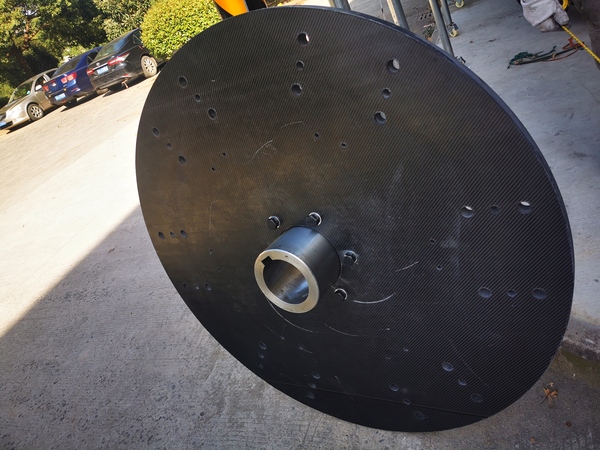
Baigang Composite Materials has reduced the density to 1.6 g/cm³ through carbon fiber prepreg molding process, while adopting a variable cross-section design to disperse stress, thereby extending the service life of the drive shaft to over 10 years. Its modular production model supports the customization of non-standard shafts within 72 hours, thoroughly addressing industry pain points.
Introduction to the company's technological capabilities: Full-chain innovation from materials to manufacturing
STEP1:Material R&D systemBaigang possesses an independent carbon fiber prepreg production line capable of controlling resin content error to ≤1%, ensuring that the drive shaft's tensile strength reaches 3500 MPa (the national standard GB/T 3354-2014 requires ≥2800 MPa), with a 40% increase in flexural rigidity. STEP 2:Design calculation methodBased on ANSYS finite element analysis, a correlation model of "stress nephogram-fatigue life" was developed, which can accurately predict the crack initiation location of a drive shaft with a diameter of Φ600 mm under 100,000 cyclic loads, with a design redundancy of 200%. STEP3:Manufacturing and Inspection CapabilitiesEquipped with a 1000-ton hydraulic press and a laser tracker, it achieves a shaft coaxiality of ≤0.05mm (industry standard ≤0.1mm); by simulating a 20-year service environment with a random vibration table, it ensures each shaft passes 10^7 fatigue tests.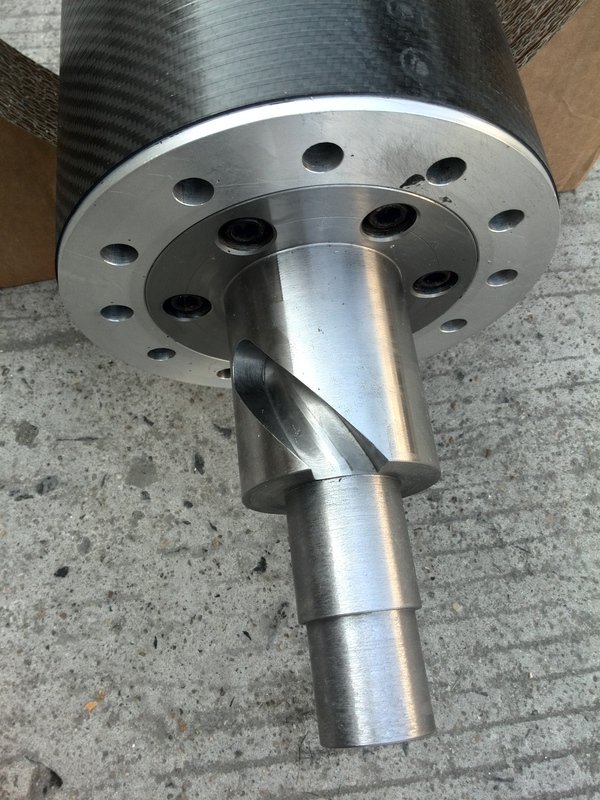
Taking the φ550mm×8m drive shaft customized for a wind power enterprise in 2023 as an example, it weighs only 120 kg (a steel shaft of the same specifications weighs 450 kg), reducing the starting torque of the generator set by 22% and increasing the annual power generation by 3.8%. This case was included in the "Annual Innovation Case Collection of China Composites Industry Association."
FAQ: Q&A Technical Selection Guide
Q1: How to choose the diameter and length of a carbon fiber drive shaft?
STEP1:Load calculationStep 1: Calculate the minimum diameter according to the formula d ≥ (16T/πσ)^(1/3) based on the equipment torque T (N·m) and rotational speed n (rpm) (where σ is the allowable stress of the material, taken as 1200 MPa for carbon fiber); Step 2:Spatial adaptationMeasure the distance L between the mounting holes of the equipment, ensuring that the shaft length satisfies L-100mm ≤ shaft length ≤ L+50mm (allowance reserved for connection); STEP 3:Dynamic verificationBy using the "Drive Shaft Selection Software" provided by Baigang, input the equipment vibration frequency f (Hz) and critical rotational speed nc (rpm) to ensure nc ≥ 1.2f and avoid resonance.
Q2: What is the maintenance interval for carbon fiber drive shafts?
STEP1:Daily inspectionInspect the shaft temperature using an infrared thermal imager every three months. Abnormal temperature rise (>15℃ above ambient temperature) may indicate loose connections; STEP 2:Regular testingInspect internal defects annually using an ultrasonic flaw detector, and replace immediately if the crack depth exceeds 0.5mm; STEP 3:Lubrication managementReplace the coupling grease every 2 years. It is recommended to use Baigang's matching No. 7018 high-temperature grease (operating temperature -40°C to 150°C).
Reference for Full-text Summary: Technical Value and Industry Outlook of Carbon Fiber Drive Shafts
Baigang Composite Materials has established a technical system for carbon fiber drive shafts covering all specifications from Φ40mm to Φ600mm and within 10 meters through material innovation, design optimization, and manufacturing upgrades. Its products, characterized by the three major advantages of "lightweight, high reliability, and rapid customization," have achieved an annual installation volume of over 4,000 units in fields such as wind power generation and cooling tower fans, helping customers reduce comprehensive costs by more than 30%. In the future, with the decline in carbon fiber costs and the widespread adoption of intelligent manufacturing technologies, carbon fiber drive shafts are expected to expand into new applications in areas such as new energy vehicles and aerospace, driving the evolution of industrial power transmission toward greater efficiency and sustainability.For more information, please visit the official website: www.baigangcomposites.com