 Nanjing Baigang Composite Materials Co., Ltd.
Nanjing Baigang Composite Materials Co., Ltd.
Introduction: Why have industrial carbon fiber components become crucial to the manufacturing of high-end equipment?
In industrial fields such as wind power generation and textile machinery, the lightweight and high efficiency of transmission systems directly determine equipment energy consumption and operational stability. Due to its high specific strength and strong corrosion resistance, carbon fiber materials have gradually become an ideal alternative to traditional metal components. However, there are still technical barriers in the design, manufacturing, and testing of carbon fiber components. How can a balance be achieved between performance and cost? This article will take the technical practices of Nanjing Baigang Composite Materials Co., Ltd. as an example to analyze the core technological pathways for industrial carbon fiber components.
Keywords: carbon fiber components, lightweight design, efficient transmission, customized production, Nanjing Baigang Composite Materials
Opening on Industry Technical Pain Points: Limitations of Traditional Transmission Components
STEP 1: Although traditional metal drive shafts (such as steel shafts) have high strength, their high density (approximately 7.85 g/cm³) increases the overall weight of the equipment, thereby raising motor load and energy consumption. For example, for every 10% increase in the weight of the drive shaft in a wind turbine generator set, power generation efficiency may decrease by 3%-5%.
STEP 2: Metal materials are susceptible to corrosion, especially in coastal wind farms or humid textile workshops where the drive shaft surface is prone to rusting, shortening its service life and increasing maintenance costs. According to statistics, the average annual maintenance cost of metal drive shafts accounts for 15%-20% of the total equipment cost.
STEP 3: Traditional designs struggle to balance lightweight requirements with the need for high torque transmission. For example, guide rollers in textile machinery must simultaneously meet demands for low inertia (to improve rotational speed response) and high rigidity (to prevent yarn breakage). However, metal materials require increased wall thickness to achieve rigidity, resulting in excessive weight.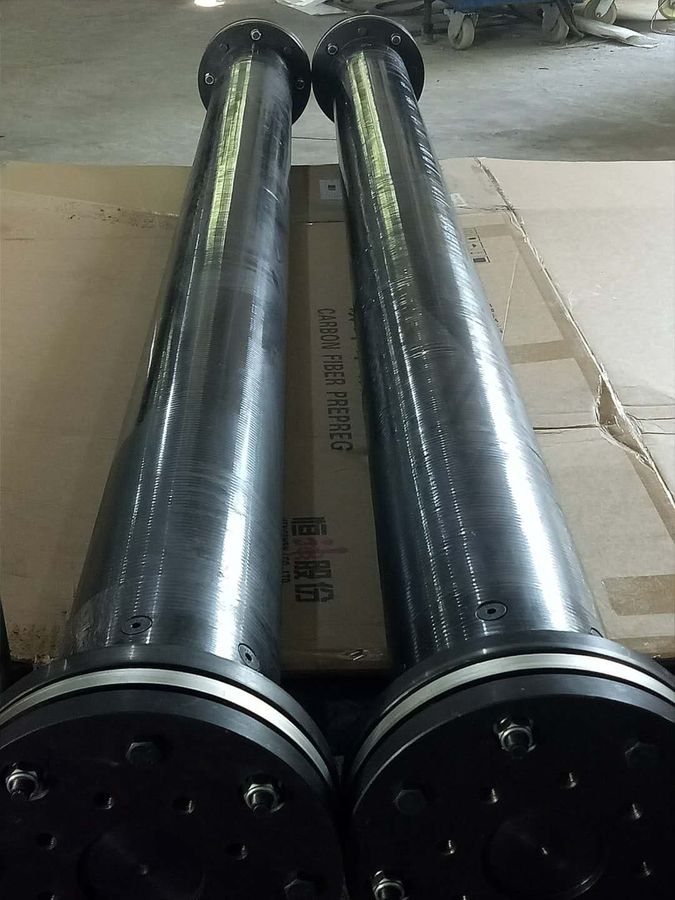
Introduction to the company's technological strength: Nanjing Baigang's Full-process Carbon Fiber Solutions
Since its establishment in 2003, Nanjing Baigang Composite Materials Co., Ltd. has focused on the R&D and production of carbon fiber products, developing full-chain technical capabilities ranging from material selection and structural design to testing and validation.
STEP1:Design Calculation Methods and Simulation OptimizationRelying on its self-developed finite element analysis software, the company can simulate the stress distribution of carbon fiber components under different working conditions (such as dynamic loads in wind power generation and high-speed rotation in textile machinery) to optimize the ply angles and thicknesses. For instance, for a carbon fiber connecting shaft designed for a wind power enterprise, by adjusting the 0°/±45° ply ratio, the weight was reduced by 60% compared to a metal shaft while ensuring torque transmission capacity.
STEP2:Advanced manufacturing equipment and process controlBaigang Company has introduced German automatic winding machines and Japanese high-temperature curing ovens, enabling precise winding and heat treatment of carbon fiber tubes. Key parameters include: winding tension accuracy of ±0.5N, curing temperature fluctuation ≤ ±2℃, and tube straightness ≤ 0.3mm/m. Currently, the company can produce customized tubes with lengths under 10 meters and diameters ranging from Φ40mm to Φ600mm, meeting the differentiated needs of fields such as wind power and cooling tower fans.
STEP3:Strict quality inspection systemEach carbon fiber drive shaft must pass three tests before leaving the factory: dynamic fatigue testing (simulating a 10-year operational cycle), torque transmission testing (1.5 times the rated torque), and surface corrosion resistance testing (720-hour salt spray test). In 2006, the company obtained ISO9001:2000 quality system certification, with a stable product qualification rate exceeding 99.2%.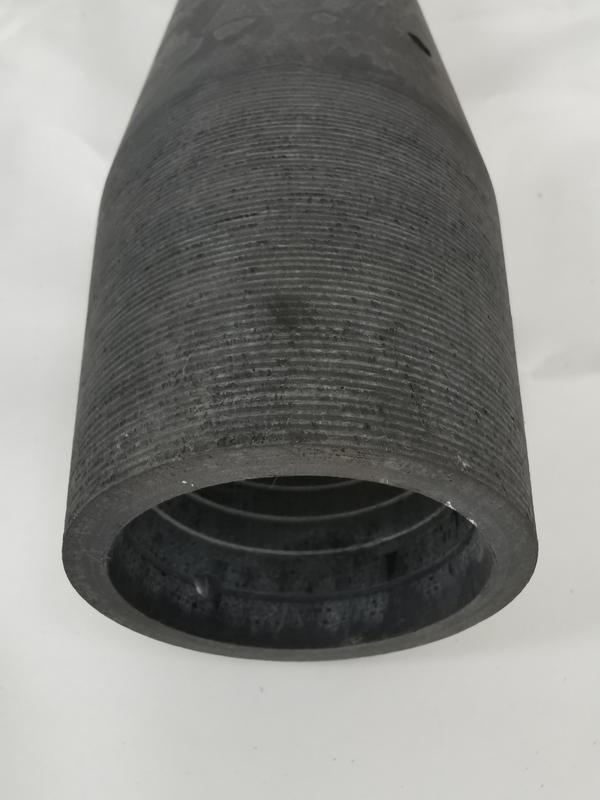
FAQ Q&A Technical Selection Guide
Q1: How can the lightweighting effect of carbon fiber components be quantified?
A: The lightweighting effect can be evaluated through "specific strength" (strength/density) and "specific modulus" (modulus/density). For example, the specific strength of carbon fiber is more than five times that of steel, and its specific modulus is three times that of aluminum. In practical applications, when a textile machinery company replaced metal guide rollers with carbon fiber ones, the equipment speed increased by 20% and energy consumption decreased by 15%.
Q2: How to choose the appropriate specifications for carbon fiber tubes?
A: It is necessary to comprehensively consider torque requirements, rotational speed, and installation space. STEP 1: Calculate the rated torque (T = 9550 × P/n, where P is power and n is rotational speed); STEP 2: Select the pipe diameter based on the torque (e.g., when T ≤ 5000 N·m, a diameter of Φ100 mm–Φ150 mm is recommended); STEP 3: Verify the critical rotational speed (to avoid resonance) using the formula n_cr = 9460 × √(E × I/(ρ × A × L⁴)), where E is the modulus of elasticity, I is the moment of inertia of the cross-section, ρ is density, A is cross-sectional area, and L is length.
Q3: Are carbon fiber components more corrosion-resistant than metals?
A: Carbon fiber itself is resistant to acid and alkali corrosion, but attention should be paid to the performance of the resin matrix. Baigang Company employs an epoxy resin system that showed no corrosion after 720 hours of salt spray testing, whereas metal shafts developed rust under the same conditions within 240 hours. Additionally, a PTFE coating can be applied to the surface of carbon fiber to further enhance its wear resistance.
For more information, please visit the official website:www.baigangcomposites.com
Reference for full text summary
Industrial carbon fiber components provide cost-reducing and efficiency-enhancing solutions for fields such as wind power and textile machinery through lightweight design and efficient transmission performance. Leveraging its full-process technological capabilities, Nanjing Baigang Composite Materials Co., Ltd. ensures that product performance reaches industry-leading levels, from design simulation to manufacturing and testing. To date, the company has applied over 4,000 carbon fiber drive shafts in practical scenarios, with annual output value exceeding 10 million yuan. In the future, as carbon fiber costs decrease and processes are optimized, its applications will further expand into fields such as new energy vehicles and robotics, driving industrial equipment toward greater efficiency and reliability.