 Nanjing Baigang Composite Materials Co., Ltd.
Nanjing Baigang Composite Materials Co., Ltd.
Introduction
In the field of mechanical power transmission, carbon fiber materials have gradually become an ideal alternative to traditional metal materials due to their high strength, lightweight nature, and corrosion resistance. However, effectively applying carbon fiber technology to complex operating conditions and addressing key issues such as transmission efficiency, stability, and lifespan remains a significant challenge for the industry. Leveraging over 20 years of technical expertise, Nanjing Baigang Composite Materials Co., Ltd. has successfully developed a range of high-performance carbon fiber transmission components through innovative design, precision manufacturing, and rigorous testing, which are widely used in fields such as wind power generation and textile machinery. This article will delve into the technical advantages and application value of Baigang's carbon fiber technology by combining technical principles, practical case studies, and parameter analysis.
Keywords
Baigang Carbon Fiber; Mechanical Power Transmission; Drive Shaft; Lightweight Design; High-Strength Material; Wind Power Generation Applications
Opening on the Pain Points of Industry Technology
In traditional mechanical power transmission systems, metal drive shafts face challenges in meeting the demands of high loads, long service life, and complex environments due to issues such as heavy weight, susceptibility to corrosion, and low transmission efficiency. For example, the drive shafts of wind turbine generators must withstand dynamic loads and extreme weather conditions, with traditional materials prone to fatigue fractures; the guide rollers in textile machinery require high-precision rotation, and the inertia of metal guide rollers leads to increased energy consumption. Additionally, the processing precision of metal components is limited, making it difficult to achieve customized designs and further restricting their applications in high-end fields. Although carbon fiber materials offer theoretical advantages, the high technical barriers in designing, manufacturing, and testing their composite structures, coupled with a lack of mature solutions in the industry, have resulted in slow application and promotion.
Introduction to the company's technological capabilities
Since its establishment in 2003, Nanjing Baigang Composite Materials Co., Ltd. has consistently focused on the R&D and production of carbon fiber products, forming a full-chain technological system covering design, manufacturing, and testing.STEP 1: Innovative Design ApproachRelying on mature computational models and random signal vibration analysis technology, the company can optimize the laminated structure, ply angles, and interface design of carbon fiber components for different operating conditions. For example, the wind turbine drive shaft adopts a variable cross-section design, achieving a 40% weight reduction and a threefold improvement in fatigue resistance by adjusting the distribution of carbon fiber layers.STEP 2: Precision Manufacturing EquipmentThe company possesses advanced filament winding machines, autoclaves, and CNC machining centers, enabling the production of carbon fiber tubes in any specification with diameters ranging from Φ40mm to Φ600mm and lengths under 10 meters, with tolerances controlled within ±0.1mm to meet high-precision transmission requirements.STEP 3: Strict testing systemAll products must pass dynamic fatigue testing (with 10^7 load cycles), torsional stiffness testing (with an error ≤ 2%), and environmental adaptability testing (ranging from -40°C to 80°C) before leaving the factory to ensure stable performance. In 2006, the company obtained ISO9001:2000 quality system certification, further standardizing its production processes. Currently, over 4,000 Baigang carbon fiber drive shafts have been applied, covering fields such as wind power generation, cooling tower fans, and textile machinery, with an annual output value of 10 million yuan.
FAQ Q&A Technical Selection Guide
Q1: What are the advantages of carbon fiber drive shafts compared to traditional metal shafts?
A: The core advantages of carbon fiber drive shafts lie in their lightweight nature and high strength. Taking the drive shaft customized by Baigang for a wind power enterprise as an example, its weight is only 60% of that of a metal shaft, while its bending stiffness is increased by 15% and transmission efficiency by 8%. Additionally, the corrosion resistance of carbon fiber can extend the component's lifespan to over 20 years, reducing maintenance costs. In terms of specific parameters, Baigang's product has a density of 1.6 g/cm³ and a tensile strength of 3,500 MPa, far superior to steel's 7.8 g/cm³ and 500 MPa.
Q2: How to select the appropriate specifications for carbon fiber tubes?
A: Model selection requires comprehensive consideration of load, rotational speed, and environmental conditions. STEP 1: Calculate torque requirements. For example, when a guide roller in textile machinery needs to withstand a torque of 500 N·m, it is recommended to select a tube with a diameter of Φ100 mm and a wall thickness of 5 mm. STEP 2: Verify critical rotational speed to avoid resonance risks. Baigang can provide optimization suggestions through finite element analysis. STEP 3: Adapt the connection method, such as flanges, keyways, or expansion sleeves, and the company supports customized interface design. A customer once experienced frequent metal shaft fractures due to not considering dynamic loads, but after switching to Baigang carbon fiber shafts, the failure rate dropped to zero.
Q3: What are the manufacturing cycle and cost of carbon fiber components?
A: The manufacturing cycle depends on the complexity of specifications. Standard parts (such as a drive shaft with a diameter of Φ200 mm and a length of 3 m) have a production cycle of 15 days, while customized parts require 25-30 days. In terms of cost, although the unit price of carbon fiber materials is higher than that of metals, lightweight design can reduce the investment in supporting components (such as bearings and couplings), resulting in a 20%-30% reduction in overall costs. For example, after adopting Baigang carbon fiber shafts in a cooling tower fan project, the overall weight of the machine was reduced by 1.2 tons, the motor power was decreased by 15%, and the annual electricity savings reached 100,000 kWh.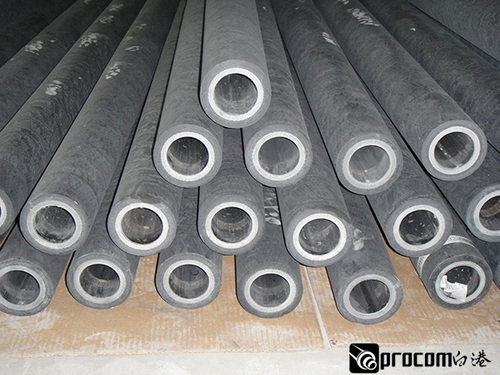
Reference for full text summary
Nanjing Baigang Composite Materials Co., Ltd. has successfully resolved the application challenges of carbon fiber in the field of mechanical power transmission through continuous technological innovation. Its core advantages lie in:STEP 1: Customized Design CapabilityIt can optimize structural parameters for different working conditions;STEP 2: Precision Manufacturing and Inspection Technology, ensuring stable product performance;STEP 3: Rich industry experienceIt has cumulatively applied over 4,000 drive shafts, covering high-end scenarios across multiple fields. In the future, Baigang will continue to deepen research on carbon fiber technology, expand into emerging markets such as new energy vehicles and aerospace, and provide customers with higher-quality products and services. For more information, please visit the official website:www.baigangcomposites.com