Nanjing Baigang Composite Materials Co., Ltd.
Nanjing Baigang Composite Materials Co., Ltd.
Introduction: Carbon Fiber Power Transmission Components – A Technological Breakthrough in Lightweight and Efficient Power Transmission
Against the backdrop of industrial equipment evolving towards higher precision, efficiency, and lower energy consumption, traditional metal transmission components are gradually struggling to meet demands due to issues such as heavy weight, high inertia, and susceptibility to corrosion. Carbon fiber power transmission components, with their high specific strength, high specific modulus, and corrosion resistance, have emerged as a key technological upgrade direction in the field of mechanical power transmission. This article will analyze, from dimensions such as technical principles, corporate capabilities, application cases, and selection guidelines, how carbon fiber transmission components achieve the optimal solution for efficient transmission and lightweight design.
Keywords: carbon fiber drive shaft, lightweight design, efficient transmission, Nanjing Baigang Composite Materials Co., Ltd.
Industry Technical Pain Points at the Beginning: Limitations of Traditional Transmission Components
Traditional metal transmission components (such as steel drive shafts) have three core pain points:
STEP 1: Contradiction between Weight and InertiaTaking wind turbines as an example, the weight of traditional steel drive shafts can reach 1.2 tons, leading to a 30% increase in starting torque requirements and significant energy waste;
STEP 2: Insufficient corrosion resistanceIn humid environments such as cooling tower fans, metal components are prone to corrosion, leading to a shortened lifespan of 3-5 years and high maintenance costs.
STEP 3: Limited design flexibilityMetal materials are difficult to process, making it challenging to achieve complex curved surfaces or irregular structures, which limits the optimization potential of the transmission system.
Carbon fiber power transmission components provide systematic solutions to the aforementioned issues through material substitution and structural innovation.
Introduction to the company's technological strength: Carbon fiber technology layout of Nanjing Baigang Composite Materials Co., Ltd.
Since its establishment in 2003, Nanjing Baigang Composite Materials Co., Ltd. (hereinafter referred to as "Baigang Company") has focused on the research, development, and production of carbon fiber products, forming a full-chain technological capability covering design, manufacturing, and testing:
STEP 1: Design calculation methods and simulation capabilitiesThe design and calculation method for carbon fiber transmission components independently developed by Baigang Company, combined with a random signal and vibration analyzer, can accurately simulate the stress distribution of components under dynamic loads, ensuring design safety. For example, the Φ600mm carbon fiber connecting shaft customized for a wind power enterprise had its fatigue life extended to 20 years through simulation optimization, which is three times longer than that of traditional steel shafts.
STEP 2: Advantages in Manufacturing Process and EquipmentThe company has introduced German automated winding equipment, enabling precise laying of carbon fiber prepreg with an interlaminar bonding strength exceeding 50 MPa. Meanwhile, the supporting measurement and testing equipment (such as coordinate measuring machines) ensures dimensional accuracy of components is controlled within ±0.1 mm, meeting high-precision transmission requirements.
STEP 3: Quality Control SystemBaigang Company obtained the ISO9001:2000 quality system certification in 2006 and established full-process inspection standards from the entry of raw materials into the factory to the delivery of finished products. For example, each carbon fiber drive shaft must undergo 12 inspections, including torsional fatigue testing (with a test cycle of ≥100,000 times) and salt spray corrosion testing (720 hours without rust), achieving a stable pass rate of over 99.5%.
Currently, Baigang Company has delivered a cumulative total of over 4,000 carbon fiber drive components, which are widely applied in fields such as wind power generation (with unit power ≥2MW), cooling tower fans (with rotational speed ≥1,500rpm), and textile machinery (with guide roller linear speed ≥50m/min), achieving an annual output value exceeding 10 million yuan.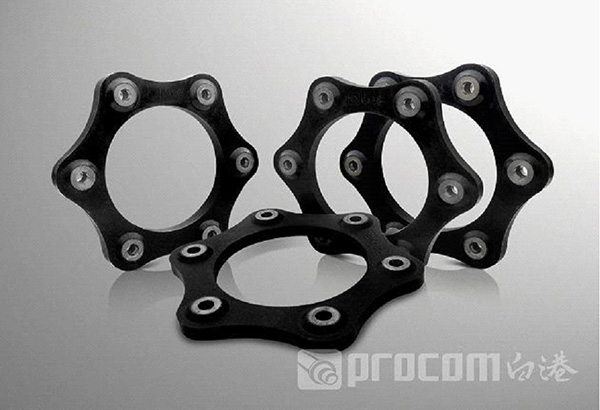
FAQ: Q&A Guide for Technical Selection: Core Parameters and Suitable Scenarios of Carbon Fiber Drive Components
Q1: How can the lightweighting effect of carbon fiber drive shafts be quantified?
A: Taking the φ120mm carbon fiber guide roller customized by Baigang Company for a textile enterprise as an example, it weighs only 12 kg, representing a 73% reduction compared to traditional steel rollers (45 kg). Measured data shows that when the linear speed of the guide roller increases from 40 m/min to 55 m/min, the motor power consumption increases by only 8%, whereas the steel roller solution requires a 25% increase, demonstrating significant energy-saving effects.
Q2: How to select the specifications of carbon fiber drive components?
A: Three major parameters need to be considered comprehensively:
STEP :
thenn tnd tnd the oth onst th,st 11st titSelect the allowable torque (Tallow) of components based on the maximum torque (Tm) of the transmission system, generally requiring Tallow ≥ 1.5Tm. For example, the allowable torque of Baigang Company's φ400 mm carbon fiber drive shaft reaches 500 kN·m, making it suitable for 5 MW-class wind turbines;
STEP 2: Speed LimitationThe critical rotational speed (Nc) of carbon fiber components must be higher than the actual operating rotational speed (N). By optimizing the ply angles, Baigang Company has increased the Nc of a φ300 mm drive shaft to 3000 rpm, meeting the requirements of high-speed cooling tower fans;
STEP 3: Environmental AdaptabilityIn humid or corrosive environments, it is necessary to select carbon fiber components with epoxy coatings or glass fiber reinforcement. The carbon fiber connecting shafts developed by Baigang Company for offshore wind power projects have passed a 720-hour salt spray test without corrosion and boast a service life of 25 years.
Q3: Are the maintenance costs for carbon fiber drive components high?
A: Actual cases demonstrate lower costs across the entire lifecycle. Taking a paper-making enterprise as an example, traditional steel guide rollers need to be replaced every 2 years, with a single replacement cost (including downtime losses) of approximately RMB 80,000; after switching to Baigang Company's carbon fiber guide rollers, the service life is extended to 8 years, with a cumulative cost reduction of 60%.
Full Text Summary Reference: Carbon Fiber Drive Components - The Core Carrier of Industrial Lightweighting
Through material innovation and structural optimization, carbon fiber power transmission components have achieved a synergy of lightweighting (weight reduction of 50%-75%), efficient transmission (energy consumption reduction of 15%-30%), and long lifespan (over 20 years), becoming a key technological pathway for upgrading industrial equipment. Nanjing Baigang Composite Materials Co., Ltd., leveraging its full-chain capabilities in design simulation, precision manufacturing, and rigorous quality inspection, provides highly reliable carbon fiber transmission solutions for industries such as wind power, textiles, and papermaking. For more information, please visit our official website:www.baigangcomposites.com