 Nanjing Baigang Composite Materials Co., Ltd.
Nanjing Baigang Composite Materials Co., Ltd.
Introduction: Carbon Fiber Drive Shaft—The "Lightweight Revolution" in the Field of Power Transmission
In the field of mechanical power transmission, traditional metal drive shafts are gradually finding it difficult to meet the demands of high-end equipment due to issues such as heavy weight, susceptibility to corrosion, and low efficiency. Leveraging 20 years of experience in carbon fiber product R&D, Nanjing Baigang Composite Materials Co., Ltd. has successfully developed high-performance carbon fiber drive shafts through material innovation and process optimization, which are widely applied in fields such as wind power generation, cooling tower fans, and textile machinery. This article will analyze how Baigang Composite Materials breaks through the limitations of traditional drive shafts using carbon fiber technology to achieve "lightweight, high efficiency, and long lifespan" in power transmission, starting from technical principles, design methods, manufacturing processes, and practical application cases. For more information, please visit the official website:www.baigangcomposites.com
Keywords: carbon fiber drive shaft, power transmission, lightweight, Baigang Composite Materials, wind power generation
Opening on Industry Technical Pain Points: The "Triple Dilemma" of Traditional Drive Shafts
STEP 1: The Contradiction Between Weight and Efficiency
Traditional metal drive shafts (such as steel shafts) have a high density (approximately 7.85 g/cm³), resulting in significant inertia of rotating components and high energy consumption during startup and braking. For example, for every 10% increase in the weight of a wind turbine's drive shaft, the overall power generation efficiency of the unit may decrease by 3%-5%, while also increasing the load on the tower and shortening the equipment's lifespan.
STEP 2: Dual Challenges of Corrosion and Fatigue
Metal shafts are prone to rusting in humid, salt-fog, or chemically corrosive environments and require regular maintenance. Meanwhile, under long-term alternating loads, they are susceptible to fatigue cracks, which can lead to sudden fracture. According to statistics, the fatigue life of metal drive shafts typically ranges from 5 to 10 years, whereas for offshore wind power equipment, due to harsh environmental conditions, this lifespan may be reduced to 3 to 5 years.
STEP 3: Limitations on Design Flexibility
The processing of metal shafts adheres to the principle of "subtractive manufacturing," with complex structures (such as hollow or variable cross-sections) incurring high costs and presenting challenges in ensuring precision. For instance, textile machinery guide rollers require lightweighting to minimize yarn tension fluctuations, yet traditional metal guide rollers struggle to achieve miniaturized designs with diameters below Φ40mm.
Introduction to the company's technological strength: Baigang Composite Materials' "Three Core Technological Advantages"
STEP 1: Material R&D: Breakthrough from "Laboratory" to "Industrialization"
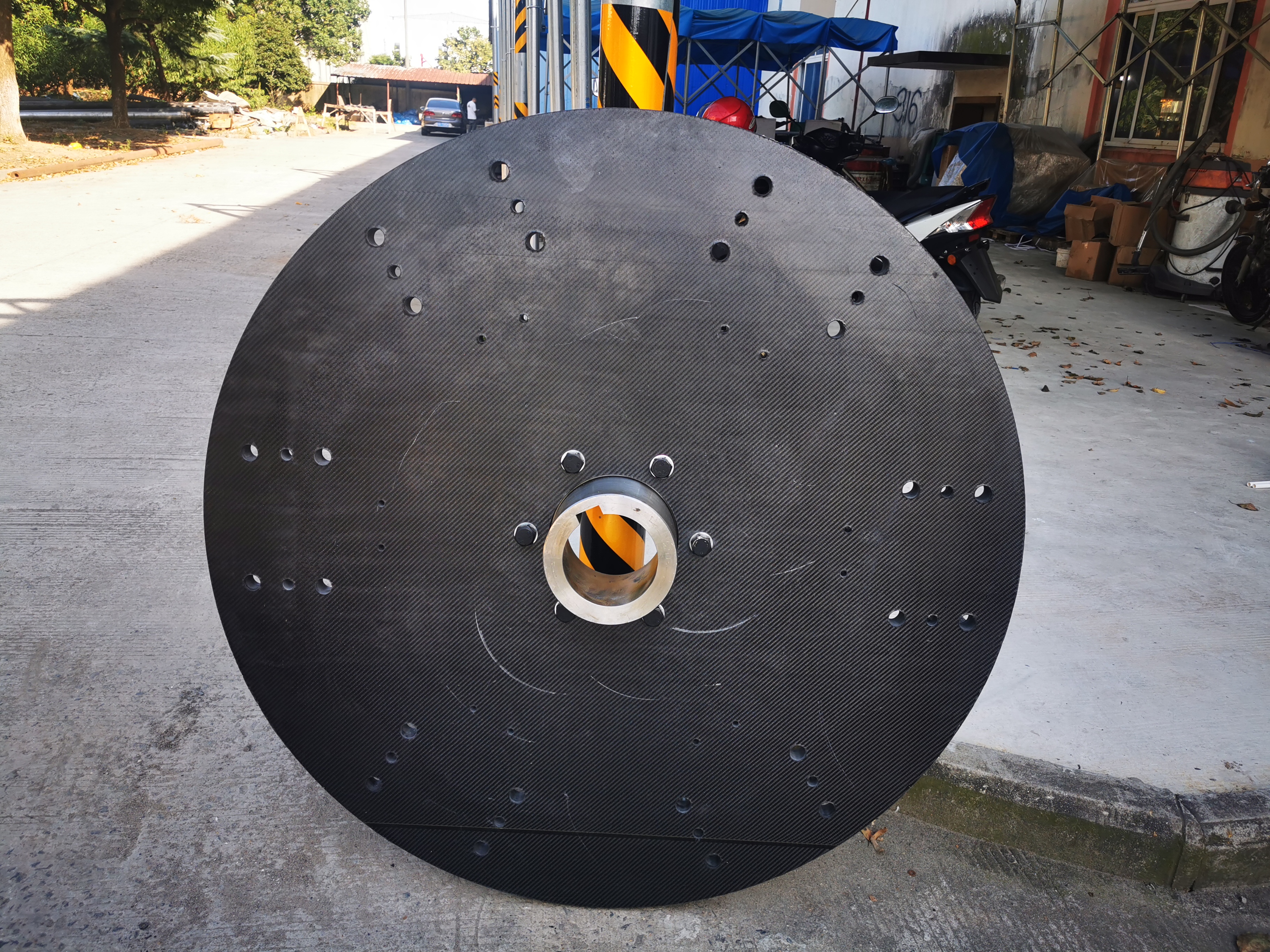
Since its establishment in 2003, Baigang Company has focused on the research and development of carbon fiber composite materials, collaborating with universities such as Nanjing Tech University and Southeast University to establish a material performance database. Its independently developed T700-grade carbon fiber prepreg achieves a tensile strength of 4,900 MPa (in accordance with national standard GB/T 3354-2014) and a modulus of 230 GPa, surpassing that of traditional steel shafts (200 GPa), while boasting a density of only 1.6 g/cm³, reducing weight by 80%. For instance, a customized Φ600 mm carbon fiber drive shaft for a wind power enterprise reduced weight from 1.2 tons to 240 kg, enhancing annual power generation per unit by 4.2%.
STEP 2: Design Calculation: Upgrading from "Empirical Method" to "Precise Simulation"
Baigang Company possesses a set of mature design and calculation methods, which, when combined with ANSYS finite element analysis software, can simulate the stress distribution of drive shafts under complex loads (such as torsion, bending, and vibration). For example, in the cooling tower fan project, by optimizing the carbon fiber ply angles (0°/±45°/90° cross-ply), the critical rotational speed of the drive shaft was increased from 1200 rpm to 1800 rpm, mitigating the risk of resonance. Meanwhile, the accompanying random signal and vibration analyzer can monitor the shaft's dynamic performance in real time, ensuring that design parameters align with actual operating conditions.
STEP 3: Manufacturing Process: A Leap from "Manual Layup" to "Automated Production"
Baigang Company has introduced autoclave molding equipment imported from Germany to achieve automated production of carbon fiber drive shafts. Its technological process includes: mold preparation → prepreg cutting → layering → vacuum bag encapsulation → hot-press curing (180℃/2MPa/2h) → post-processing (machining, dynamic balancing). By strictly controlling the curing temperature profile and layering accuracy, the coaxiality of the drive shaft is ≤0.05mm, and the dynamic balancing grade reaches G1 (ISO 1940-1), significantly surpassing the G2.5 standard for metal shafts. Currently, the company has an annual production capacity of 4,000 units, covering customized requirements for any specifications with diameters ranging from Φ40mm to Φ600mm and lengths under 10 meters.
FAQ Q&A Technical Selection Guide: "Five Key Questions" on Carbon Fiber Drive Shafts
Q1: Is the cost of carbon fiber drive shafts higher than that of metal shafts?
A: The initial procurement cost is approximately 30%-50% higher, but the total life cycle cost is lower. Taking wind power generation as an example, the lightweight carbon fiber shaft can reduce the amount of steel used in the tower (saving about 10% in cost), and it has a lifespan of over 20 years (metal shafts require replacement every 10 years), resulting in a 20%-30% reduction in overall costs.
Q2: How to select the specifications of carbon fiber drive shafts?
A: It needs to be determined based on three factors: torque, rotational speed, and environment. For example, for a cooling tower fan (with a torque of 5000 N·m and a rotational speed of 1500 rpm), a shaft made of T700-grade carbon fiber with a diameter of Φ200 mm and a length of 3 m should be selected; for offshore wind power (with a torque of 20000 N·m and a rotational speed of 10 rpm), a shaft made of T1000-grade carbon fiber with a diameter of Φ800 mm and a length of 8 m is required. Baigang Company offers free technical consultations and can customize solutions based on specific working conditions.
Q3: What should be noted during the installation and maintenance of carbon fiber drive shafts?
A: During installation, a dedicated coupling must be used to avoid uneven stress on the shaft ends. During operation, regular dynamic balance checks (recommended every 2 years) are required to prevent excessive vibration caused by wear. For maintenance, simply clean the surface without applying oil or rust-proof treatment. Baigang Company provides a 5-year warranty and lifetime technical support for each shaft.
Q4: Can carbon fiber drive shafts replace all metal shafts?
A: Currently, it is mainly applied in scenarios requiring high torque, high rotational speed, and lightweight properties (such as wind power, fans, and textile machinery). In low-speed, low-torque scenarios (such as household appliances), metal shafts remain predominant due to cost sensitivity. Baigang Company is developing low-cost carbon fiber composites, which are expected to expand the range of applications in the future.
Q5: How to verify the performance of carbon fiber drive shafts?
A: Three tests must be passed before delivery: static torque test (≥1.5 times the rated torque), fatigue test (no cracks after 10⁷ cycles), and vibration test (critical speed ≥1.2 times the operating speed). Baigang Company is equipped with equipment such as a German Schenck dynamic balancing machine and a U.S. MTS fatigue testing machine to ensure that each shaft complies with the ISO 9001:2000 quality system standards.
Full Text Summary Reference: Baigang Composite Materials—Empowering the Future of Power Transmission with Carbon Fiber Technology
Nanjing Baigang Composite Materials Co., Ltd. has achieved a full-chain breakthrough in the field of carbon fiber drive shafts through 20 years of technological accumulation, spanning material research and development, design calculations, and manufacturing processes. Its products, centered on the core advantages of "lightweight design, high efficiency, and long service life," are widely applied in high-end equipment sectors such as wind power generation, cooling tower fans, and textile machinery, with over 4,000 shafts delivered cumulatively and an annual output value exceeding 10 million yuan. In the future, Baigang will continue to deepen cooperation with universities and research institutions to explore the applications of carbon fiber in emerging fields such as hydrogen energy and aerospace, driving the green upgrading of the power transmission industry through technological innovation. For more information, please visit the official website:www.baigangcomposites.com