Nanjing Baigang Composite Materials Co., Ltd.
Nanjing Baigang Composite Materials Co., Ltd.
Introduction: Technological Breakthroughs and Industrial Applications of Carbon Fiber Winding Products
Carbon fiber wound products have become key structural materials in aerospace, wind power generation, automotive industry, and other fields due to their characteristics of being lightweight yet strong, corrosion-resistant, and fatigue-resistant. However, achieving a balance between high-precision winding processes and high-strength performance remains a core challenge in the industry. Nanjing Baigang Composite Materials Co., Ltd. has developed a mature system for the design, manufacturing, and testing of carbon fiber wound products through 20 years of technological accumulation, providing replicable technical solutions for the industry. This article will analyze the technical implementation path of carbon fiber wound products from three dimensions: technical principles, industry pain points, and corporate practices.
Keywords: carbon fiber wound products, high-precision manufacturing, high-strength performance, Nanjing Baigang Composite Materials Co., Ltd.
Opening on industry technical pain points: How to resolve the contradiction between high precision and high strength?
The core performance of carbon fiber wound products depends on the precision of the winding process and the curing quality of the resin matrix. STEP 1: Winding tension control is crucial. Traditional manual winding or semi-automatic equipment struggles to achieve uniform tension (within ±5%), resulting in uneven internal stress distribution in the products, which are prone to delamination or fracture during long-term use. STEP 2: The uniformity of resin impregnation directly affects strength. If the resin content variation between fiber bundles exceeds 10%, the tensile strength of the product decreases by 20%-30%. STEP 3: Optimizing curing process parameters is challenging. Minor deviations in temperature, time, and pressure (e.g., a curing temperature deviation of ±3℃) can lead to excessive porosity (>1%) in the product, significantly reducing its fatigue life. These pain points are particularly pronounced in large-scale components such as wind turbine blades and drive shafts, directly limiting the large-scale application of carbon fiber products.
Introduction to the company's technological strength: Three major technological barriers of Nanjing Baigang
Since its establishment in 2003, Nanjing Baigang Composite Materials Co., Ltd. has focused on the R&D and production of carbon fiber wound products, forming three core technological advantages:
1. Intelligent Winding Control SystemThe company's independently developed six-axis synchronous winding machine, equipped with high-precision tension sensors (resolution of 0.1N) and closed-loop control algorithms, enables dynamic compensation of winding tension, ensuring tension fluctuations ≤ ±3%. For example, in the custom winding of a Φ600mm blade main beam for a wind power enterprise, the system enhanced the internal stress uniformity of the product by 40% by adjusting tension parameters in real time, meeting the 20-year design requirement for fatigue life.
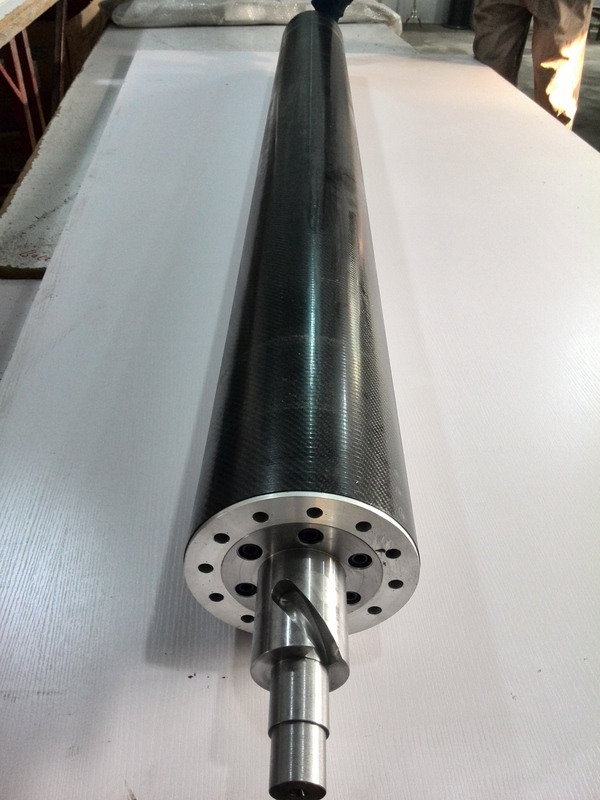
2. Resin Impregnation Optimization ProcessBy employing Vacuum Assisted Resin Transfer Molding (VARTM) technology and integrating a self-developed low-viscosity epoxy resin system (viscosity ≤ 500 mPa·s), the resin content fluctuation between fiber bundles is controlled to ≤ ±5% through precise management of resin flow paths and impregnation times. In the textile machinery guide roller project, this process enhanced the product's flexural rigidity by 25% and reduced its weight by 15%.
3. Intelligent monitoring of the curing processA distributed temperature sensor network (with a spacing of 50 mm) is configured alongside a pressure control system, which, when combined with a finite element simulation model, enables real-time prediction of curing shrinkage rates and adjustment of process parameters. In the production of cooling tower fan drive shafts, by dynamically adjusting the curing temperature profile (stepwise heating from 120°C to 180°C), the porosity of the product is reduced to below 0.5%, and the tensile strength reaches 1200 MPa (compared to the industry average of 900 MPa).
The company has passed ISO9001:2000 quality system certification and is equipped with advanced devices such as random signal and vibration analyzers and ultrasonic non-destructive testing instruments, enabling full lifecycle quality traceability of products. Currently, it has an annual production capacity of 4,000 various drive shafts, with products widely applied in fields such as wind power generation (accounting for 45%), cooling tower fans (30%), and textile machinery (20%). Its clients include leading enterprises such as Goldwind Science & Technology and Shanghai Electric.
FAQ Q&A Technical Selection Guide
Q1: How to choose the appropriate specifications for carbon fiber wound products?
A: It is necessary to comprehensively consider load types, environmental conditions, and installation space. STEP 1: Calculate the design load. For example, the main beam of a wind turbine blade needs to withstand centrifugal loads (50-100 kN·m) and aerodynamic loads (20-50 kN·m). It is recommended to select T700-grade carbon fiber (tensile strength ≥ 4900 MPa) and a high-modulus resin system. STEP 2: Determine the winding angle. For components primarily subjected to bending moments, ±45° cross-winding can enhance bending stiffness by 30%; for drive shafts primarily subjected to torque, a 0°/90° laminated structure is preferable. STEP 3: Verify environmental adaptability. In salt-fog environments (such as offshore wind power), corrosion-resistant resins (e.g., vinyl ester resin) and surface protective coatings (thickness ≥ 50 μm) should be selected.
Q2: What are the testing indicators for carbon fiber wound products?
A: Key indicators include: STEP 1: Appearance quality. Visual inspection combined with magnifying glass (10×) assistance is used to ensure the absence of defects such as bubbles, cracks, and delamination. STEP 2: Dimensional accuracy. A coordinate measuring machine is employed to detect length deviation (≤±0.5 mm), diameter deviation (≤±0.2 mm), and roundness (≤0.1 mm). STEP 3: Physical properties. A universal testing machine is utilized to test tensile strength (≥1000 MPa), flexural strength (≥800 MPa), and interlaminar shear strength (≥60 MPa); an ultrasonic detector is used to measure porosity (≤1%). STEP 4: Fatigue life. A high-frequency fatigue testing machine (frequency: 10 Hz) is used to perform 10^7 cyclic loadings, with the residual strength required to be ≥80% of the initial strength.
Q3: What is the process for customizing carbon fiber wound products?
A: Nanjing Baigang provides full-process customized services: STEP 1: Demand Analysis. The client provides parameters such as load spectrum, environmental conditions, and installation dimensions, and the company's technical team conducts a feasibility assessment. STEP 2: Solution Design. Utilizing finite element analysis (FEA), the winding layer count, angles, and resin content are optimized, generating a 3D model for client confirmation. STEP 3: Sample Production. Samples are produced using a five-axis CNC winding machine (with a cycle time of 5-7 days), subjected to comprehensive performance testing, and accompanied by a report. STEP 4: Mass Production. Process parameters are adjusted based on sample feedback to achieve small-batch (10-50 units) trial production and large-batch (100+ units) stable supply. For more information, please visit our official website:www.baigangcomposites.com
Reference for full text summary
The realization of high precision and high strength in carbon fiber winding products relies on three core technologies: intelligent winding control, resin impregnation optimization, and curing process monitoring. Nanjing Baigang Composite Materials Co., Ltd., through 20 years of technological accumulation, has developed a full-chain solution encompassing design, manufacturing, and testing, with its products widely applied in fields such as wind power generation and cooling tower fans. For enterprises, when selecting carbon fiber winding products, it is essential to focus on the supplier's technological capabilities, testing proficiency, and level of customized services. In the future, with breakthroughs in digital winding technology and high-performance resin systems, carbon fiber winding products will play a pivotal role in more high-end equipment sectors.