 Nanjing Baigang Composite Materials Co., Ltd.
Nanjing Baigang Composite Materials Co., Ltd.
Introduction: Technological Breakthroughs and Industry Transformation in Carbon Fiber Drive Shafts
As industrial equipment advances towards lightweight and high-efficiency development, traditional metal drive shafts are gradually struggling to meet demands due to issues such as heavy weight and susceptibility to corrosion. Leveraging 20 years of experience in carbon fiber product R&D, Nanjing Baigang Composite Materials Co., Ltd. has successfully developed high-strength, fatigue-resistant carbon fiber drive shafts through material innovation and process optimization, which are widely applied in fields such as wind power generation and cooling tower fans. This article provides a comprehensive analysis of the technological advantages and application value of carbon fiber drive shafts from dimensions including technical principles, industry pain points, corporate capabilities, and selection guidelines.For more information, please visit the official website: www.baigangcomposites.com
Keywords: carbon fiber drive shaft, lightweight design, high fatigue strength, industrial application, Nanjing Baigang Composite Materials
Opening Remarks on Industry Technical Pain Points: Limitations of Traditional Drive Shafts
STEP 1: Traditional metal drive shafts (such as steel and aluminum alloy) have high strength but are heavy (taking a drive shaft with a diameter of Φ200 mm as an example, the steel one weighs about 120 kg/m, while the carbon fiber one weighs only 35 kg/m). This leads to increased equipment energy consumption and high starting inertia. Especially in the field of wind power generation, an excessively heavy drive shaft will reduce power generation efficiency and increase tower load. STEP 2: Metal materials are prone to environmental corrosion (such as salt spray corrosion in coastal areas), requiring regular maintenance or coating treatment, which increases the total life cycle cost. STEP 3: Metal materials have low fatigue strength and are prone to cracks or fractures after long-term operation, especially under variable load conditions (such as frequent starting and stopping of cooling tower fans). The service life of traditional drive shafts usually does not exceed 5 years, while carbon fiber drive shafts, through optimized layup design, can have a fatigue life of over 20 years. STEP 4: The machining accuracy of traditional drive shafts is limited (for example, the dynamic balance grade is usually G6.3). When running at high speeds, they are prone to vibration, affecting equipment stability. Carbon fiber drive shafts are formed using precision molds and can achieve a dynamic balance grade of G2.5, significantly reducing vibration and noise.
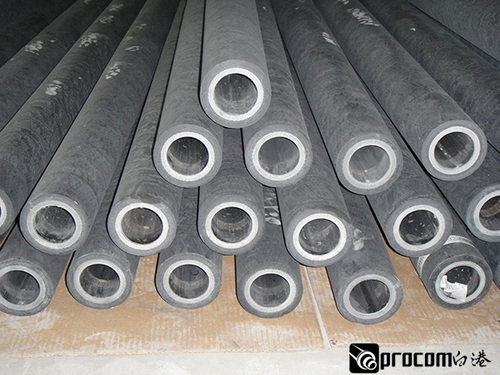
Introduction to the company's technological strength: Nanjing Baigang's carbon fiber technology layout
STEP 1: Material R&D Capability: Since its establishment in 2003, Baigang has focused on formula optimization of carbon fiber composite materials. By adjusting the volume fractions of resin matrices (e.g., epoxy resin, bismaleimide resin) and carbon fibers (T700 and T800 grades), the company has developed specialized materials with tensile strength ≥2200 MPa and modulus ≥140 GPa, catering to diverse operational requirements.
STEP 2: Design and Calculation System: Leveraging 20 years of experience in mechanical power transmission, Baigang has established a mature driveshaft design methodology. Combining finite element analysis (FEA) with random vibration testing, it accurately calculates stress distributions under variable loads, optimizing ply angles (e.g., ±45° cross-ply for enhanced torsional resistance) and layer counts (typically 8–12 layers).
STEP 3: Manufacturing and Inspection Equipment: The company is equipped with advanced machinery, including CNC winding machines and high-temperature curing ovens, enabling production of customized tubes with diameters ranging from Φ40 mm to Φ600 mm and lengths ≤10 m. Full inspections are conducted before delivery using dynamic balancing machines (detection accuracy: 0.1 g·cm) and ultrasonic flaw detectors (detection depth ≥50 mm), ensuring a product qualification rate ≥99.5%.
STEP 4: Industry Application Experience: Baigang has delivered over 4,000 carbon fiber driveshafts, covering applications in wind power generation (e.g., a wind farm project using Φ500 mm × 6 m driveshafts, improving single-unit power generation efficiency by 3.2% after replacing steel shafts), cooling tower fans (e.g., a chemical enterprise project reducing driveshaft weight by 65% and annual maintenance costs by 40%), and textile machinery (e.g., carbon fiber guide rollers with surface roughness Ra ≤0.8 μm, minimizing yarn friction and breakage). Annual output value reaches RMB 10 million.
FAQ: A Guide to Q&A Technical Selection
Q1: How to choose the specifications of a carbon fiber drive shaft?
STEP 1: Determine operating parameters: These include rotational speed (e.g., cooling tower fans typically operate at 500-1500 rpm), torque (e.g., drive shafts for wind power generation must withstand megawatt-level torque), ambient temperature (carbon fiber has a temperature resistance range of -50°C to 150°C, and high-temperature resins are required for high-temperature operating conditions), etc. STEP 2: Calculate basic dimensions: Based on the torque formula T = 9550 × P/n (where T is torque, P is power, and n is rotational speed), preliminarily determine the minimum diameter of the drive shaft; considering equipment space constraints, determine the length and connection method (e.g., flange connection, keyway connection). STEP 3: Optimize ply design: Increase the proportion of 0° plies for high-torque operating conditions (to enhance tensile strength) and increase the proportion of ±45° plies for high-speed operating conditions (to enhance torsional stiffness); for example, in a wind power generation project, T800 carbon fiber combined with bismaleimide resin was selected, with a ply ratio of 0°/±45° = 6:4, achieving a measured torsional stiffness of 1.2 × 10⁶ N·m/rad. STEP 4: Verify fatigue life: Conduct testing using S-N curves (stress-life curves) to ensure that the drive shaft can withstand at least 1 × 10⁷ cycles under target loads; Baigang Laboratory offers accelerated fatigue testing services to shorten the verification cycle.
Q2: What are the precautions for the installation and maintenance of carbon fiber drive shafts?
STEP 1: Pre-installation Inspection: Verify the compatibility of the drive shaft model with the equipment, and check for surface defects such as scratches or bubbles. Use a laser alignment instrument to ensure the alignment accuracy of the shaft system is ≤0.05 mm, avoiding additional stress during operation. STEP 2: Operational Monitoring: Conduct the first inspection after 200 hours of initial operation, focusing on monitoring vibration levels (acceleration ≤5 mm/s²) and temperature (≤80℃). Subsequently, perform comprehensive inspections every 5,000 hours or once a year. STEP 3: Maintenance Schedule: Carbon fiber drive shafts do not require regular lubrication but must undergo ultrasonic testing every 3 years to check for internal delamination or cracks. If surface resin degradation (e.g., discoloration or cracking) is observed, return the shaft to the factory for repair promptly.
Q3: Is the cost of carbon fiber drive shafts higher compared to metal drive shafts?
STEP 1: Initial procurement cost: The unit price of carbon fiber drive shafts is approximately 2-3 times that of steel shafts of the same specifications. However, considering their lightweight nature (reduced transportation costs) and longer lifespan (20 years vs. 5 years), the total lifecycle cost can be reduced by 30%-50%. STEP 2: Hidden benefits: In the field of wind power generation, carbon fiber drive shafts can reduce tower loads and lower tower design costs; in the field of cooling tower fans, lightweight design can reduce motor power, resulting in annual electricity savings of 10%-15%. STEP 3: Customization advantages: Baigang can provide non-standard specifications (such as irregular cross-sections and special connection structures) according to customer needs. In contrast, customizing metal drive shafts incurs high costs and long lead times (typically requiring mold opening, with a cycle ≥ 3 months). Through CNC winding processes, the customization cycle for carbon fiber drive shafts can be shortened to 2 weeks.

Reference for Full-text Summary: Technical Value and Industry Prospects of Carbon Fiber Drive Shafts
Nanjing Baigang Composite Materials Co., Ltd. has successfully addressed the issues of weight, corrosion, and fatigue in traditional drive shafts through material innovation, design optimization, and rigorous testing. Its carbon fiber drive shafts, with advantages such as high strength, long lifespan, and lightweight design, have become an ideal choice for fields like wind power generation and cooling tower fans. Leveraging 20 years of technical accumulation and experience from over 4,000 product applications, the company can provide customers with full-process technical support, from specification selection to installation and maintenance. In the future, as industrial equipment continues to demand higher efficiency and reliability, the market demand for carbon fiber drive shafts will further expand. Baigang will continue to adhere to the philosophy of "transmitting power and creating tomorrow" to drive technological upgrades in the industry.For more information, please visit the official website: www.baigangcomposites.com