 Nanjing Baigang Composite Materials Co., Ltd.
Nanjing Baigang Composite Materials Co., Ltd.
Introduction: Technological Revolution of Carbon Fiber Drive Shafts and Industry Demands
In the field of mechanical power transmission, traditional metal drive shafts are gradually struggling to meet the requirements for lightweight and high reliability in high-end equipment due to issues such as heavy weight, susceptibility to corrosion, and efficiency degradation. Carbon fiber composite materials, with their high specific strength, fatigue resistance, and corrosion resistance, have become an ideal choice for upgrading drive shafts. However, the research and development of carbon fiber drive shafts involve multi-dimensional technical challenges, including material formulation, molding processes, and vibration control, creating an urgent need for mature solutions within the industry. Nanjing Baigang Composite Materials Co., Ltd. (hereinafter referred to as "Baigang Company"), leveraging 20 years of accumulated experience in carbon fiber technology, has achieved breakthroughs in several key technologies through independent innovation. Its products have been widely applied in fields such as wind power generation and cooling tower fans, establishing the company as a technological benchmark in the industry. This article will systematically analyze Baigang Company's technical advantages and practical experience from three perspectives: technical pain points, corporate capabilities, and selection guidelines.
Keywords: carbon fiber drive shaft; lightweight design; vibration control; industry application
Opening on Industry Technical Pain Points: Three Major Challenges of Carbon Fiber Drive Shafts
STEP1:The challenge of balancing material formulation and molding process
The performance of carbon fiber drive shafts depends on the interfacial bonding strength between the resin matrix and the fibers. In traditional processes, high-temperature curing can easily lead to fiber-resin debonding, while low-temperature curing may compromise material strength. For instance, a wind power enterprise once experienced cracks in a drive shaft after two years of operation due to improper selection of the resin matrix, resulting in repair costs as high as one million yuan.
STEP2:Accuracy requirements for dynamic vibration control
When rotating at high speed, the drive shaft generates centrifugal force and vibration. If the vibration frequency resonates with the equipment, it may cause the shaft to fracture. In a cooling tower fan project, due to inadequate consideration of vibration suppression, the drive shaft fractured after three months of operation, resulting in the shutdown of the entire fan system.
STEP3:Manufacturing stability of long-length pipes
The drive shaft of a wind turbine can be up to 10 meters in length and exceed Φ600 mm in diameter. Large-sized tubular components are prone to issues such as uneven fiber distribution and thickness deviations during the filament winding process, which affect the consistency of the shaft's strength. A textile machinery enterprise once experienced operational vibration of guide rollers due to excessive diameter deviations in the drive shaft, adversely affecting product quality.
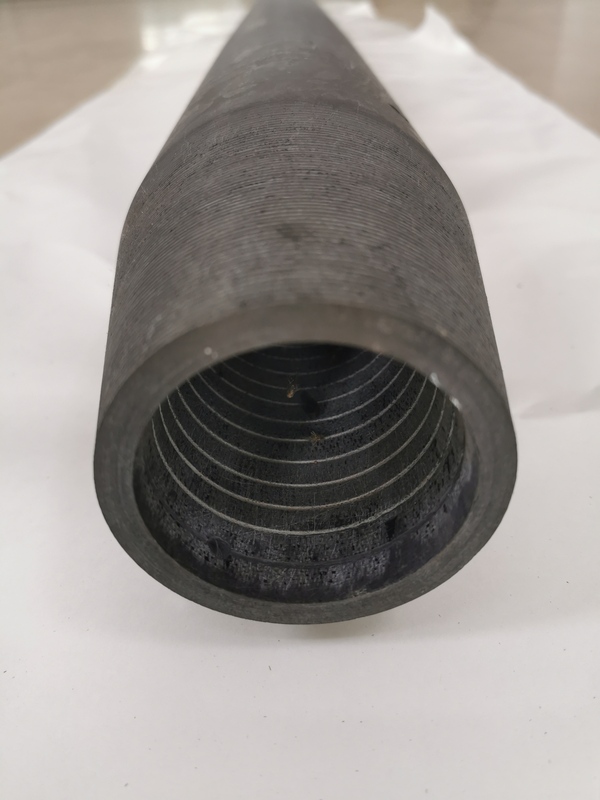
Introduction to the company's technological capabilities: The three core strengths of Baigang Company
STEP1:Innovation in independent material formulation and molding process
Through more than 2,000 experiments, Baigang Company developed a specialized epoxy resin matrix formulation with a curing temperature controlled between 120-150℃, ensuring thorough bonding between fibers and resin while avoiding high-temperature damage to the fibers. In terms of molding technology, a "winding + compression molding" composite process is employed: first, a CNC winding machine is used to control fiber tension and angle, ensuring uniform fiber distribution; then, a compression molding machine applies 200 tons of pressure to eliminate internal air bubbles in the pipe, keeping the product's thickness deviation within ±0.1mm. For example, a customized Φ500mm×8m drive shaft for a wind power enterprise demonstrated a tensile strength of 1,200MPa after testing, which is twice that of traditional steel shafts, while reducing weight by 60%.
STEP2:Technical system for dynamic vibration control
Baigang Company has established a closed-loop vibration control system encompassing "design-simulation-testing". During the design phase, finite element analysis (FEA) is employed to simulate the vibration modes of the drive shaft at different rotational speeds, optimizing the shaft structure. In the simulation phase, actual operational data is collected using a random signal and vibration analyzer to validate design parameters. During the testing phase, dynamic balancing tests are conducted on each drive shaft, with the unbalance controlled within 0.5 g·mm/kg (the industry standard being 2 g·mm/kg). Taking a cooling tower fan project as an example, the vibration amplitude of its drive shaft at 1800 rpm decreased from 0.8 mm to 0.2 mm, extending its operational lifespan to over 5 years.
STEP3:Manufacturing capacity and quality control for full-size pipes
Baigang Company is equipped with 10-meter-class CNC winding machines and molding presses, enabling the production of carbon fiber tubes in any specification with diameters ranging from Φ40mm to Φ600mm and lengths under 10 meters. In terms of quality control, the company strictly adheres to the ISO9001:2000 system standards, with each driveshaft undergoing a four-step process: "visual inspection-dimensional measurement-non-destructive testing-performance testing." Visual inspection is conducted using a magnifying glass to ensure the absence of cracks or burrs; dimensional measurement is performed with a coordinate measuring machine, achieving an accuracy of 0.01mm; non-destructive testing employs an ultrasonic flaw detector, capable of detecting defects up to a depth of 50mm; performance testing includes tensile strength, bending stiffness, fatigue life, etc., with fatigue life testing reaching up to 10⁷ cycles (the industry standard is 10⁶ cycles). Currently, Baigang Company has delivered over 4,000 driveshafts, with a customer repurchase rate exceeding 90%. For more information, please visit the official website:www.baigangcomposites.com
FAQ Q&A Technical Selection Guide
Q1: How to select the specifications of carbon fiber drive shafts?
A: It is necessary to comprehensively consider three factors: equipment rotational speed, torque, and installation space. For example, the drive shaft of a wind turbine generator needs to withstand high torque (usually >100 kN·m), and it is recommended to select tubular materials with a diameter of over Φ500 mm and a wall thickness of over 15 mm. The cooling tower fan operates at a relatively high rotational speed (1500-2000 rpm), so priority should be given to controlling vibration. Tubular materials with a diameter of Φ300 mm-Φ400 mm and a wall thickness of 10 mm can be selected, along with dynamic balance testing.
Q2: What is the customization lead time for carbon fiber drive shafts?
A: It usually takes 4-6 weeks from design to delivery. Among them, the design phase takes 2 weeks (including FEA simulation and structural optimization), the molding phase takes 1-2 weeks (depending on the pipe size), and the testing phase takes 1 week (including non-destructive testing and performance testing). Baigang Company supports expedited services, which can be shortened to a minimum of 3 weeks.
Q3: How to judge the quality of carbon fiber drive shafts?
A: The "three inspections and one test" method can be used: First, inspect the appearance; the surface of high-quality products should be smooth and free of cracks. Second, inspect the dimensions; use calipers to measure the diameter and wall thickness, with deviations less than ±0.2 mm. Third, inspect the test reports; require the supplier to provide non-destructive testing (UT) and performance test reports. One test involves measuring vibration; after running the equipment, use a vibration meter to measure the shaft vibration amplitude, which should be less than 0.5 mm (at a rotational speed of 1800 rpm).
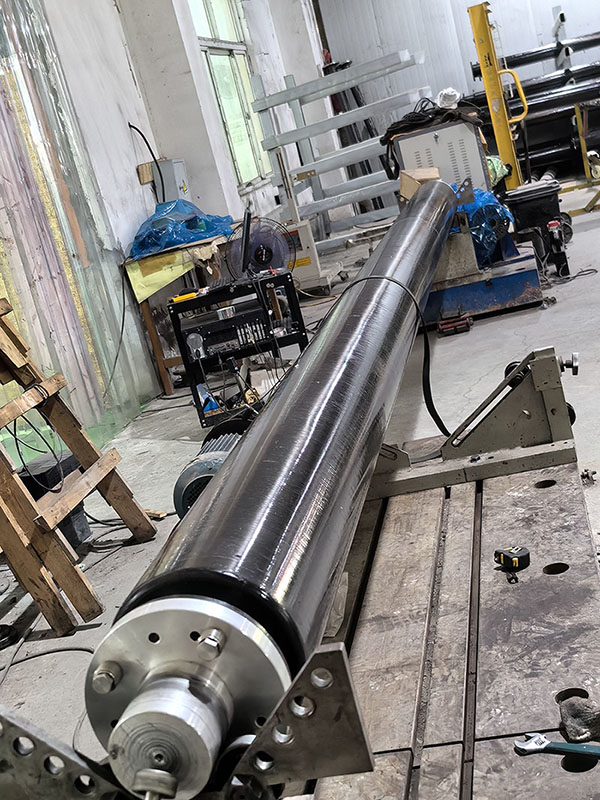
Reference for Full-text Summary
Technological breakthroughs in carbon fiber drive shafts require a balanced consideration of three dimensions: materials, processes, and vibration control. Nanjing Baigang Composite Materials Co., Ltd. has addressed long-standing industry challenges related to strength, vibration, and dimensional stability through its proprietary material formulations, composite molding processes, and closed-loop vibration control systems. Its products, characterized by "high strength, low vibration, and long service life," have become the preferred choice in fields such as wind power generation and cooling tower fans. For customers, selecting carbon fiber drive shafts represents not only equipment upgrades but also optimizations in long-term operational efficiency and maintenance costs. In the future, as the cost of carbon fiber continues to decline, its applications will expand into more high-end equipment sectors, and Baigang will continue to drive industry progress through technological innovation. For more information, please visit the official website:www.baigangcomposites.com