Nanjing Baigang Composite Materials Co., Ltd.
Nanjing Baigang Composite Materials Co., Ltd.
Introduction: Technological Innovation and Industrial Value of Composite Material Transmission Components
In the field of mechanical power transmission, traditional metal transmission components are gradually struggling to meet the application requirements of high efficiency, lightweight design, and long service life due to issues such as heavy weight, susceptibility to corrosion, and short fatigue life. Composite transmission components have emerged as a key technological alternative to metals, owing to their superior specific strength, specific modulus, and corrosion resistance. This article focuses on the carbon fiber transmission components of Nanjing Baigang Composite Materials Co., Ltd., analyzing their technical principles, manufacturing processes, and industry applications to provide engineers with references for technology selection and optimization.
Keywords: Composite material transmission components; Carbon fiber technology; Mechanical power transmission; Customized design; Nanjing Baigang
Opening on Industry Technical Pain Points: Limitations of Traditional Transmission Components
Traditional metal transmission components (such as steel drive shafts) face three core pain points during long-term operation:
STEP 1: The contradiction between weight and efficiencyThe high density of metals (approximately 7.85 g/cm³ for steel) results in significant inertia in the transmission system, leading to high energy consumption during startup and braking, particularly in scenarios requiring frequent start-stop operations, such as wind power generation and cooling tower fans, where energy losses are notable.
STEP 2: Corrosion and Fatigue IssuesMetals are prone to electrochemical corrosion in humid, salt-fog, and other environments, and the shedding of surface coatings can accelerate the propagation of fatigue cracks, increasing the risk of drive shaft fracture. According to statistics, the average fatigue life of metal drive shafts is approximately 5-8 years, while this can be reduced to 3-5 years in corrosive environments.
STEP 3: Limited design flexibilityMetal processing requires forging, turning, and other processes to achieve complex shapes, but bending deformation easily occurs when the length-to-diameter ratio exceeds 1:15, limiting the application of drive shafts in narrow spaces or long-distance transmission. For example, for slender guide rollers with a diameter below Φ40 mm in textile machinery, it is difficult for metallic materials to balance both strength and rigidity.
Introduction to the company's technological strength: Breakthrough in carbon fiber technology by Nanjing Baigang
Since its establishment in 2003, Nanjing Baigang Composite Materials Co., Ltd. has focused on the R&D and production of carbon fiber products, forming a full-chain technological system encompassing material selection, structural design, manufacturing, and testing. Its core advantages are reflected in the following three aspects:
STEP 1: Material and Process OptimizationThe company utilizes T700 and T800 grade high-modulus carbon fiber prepregs, controlling fiber orientation and interlaminar bonding strength through compression molding technology, thereby tripling the bending stiffness of the drive shaft (reaching 210 GPa) while reducing its weight by 60% (taking a drive shaft with a diameter of Φ100 mm and a length of 2 m as an example, the carbon fiber version weighs only 12 kg, whereas the steel version weighs 30 kg).
STEP 2: Design calculation methodBased on finite element analysis (FEA) and random vibration testing, the company has developed specialized design software capable of simulating the stress distribution of drive shafts under dynamic loads and optimizing tube wall thickness and connection structures. For instance, for a carbon fiber connecting shaft designed for wind turbines, by adding an intermediate flange and a variable-diameter transition section, the maximum stress was reduced from 280 MPa to 150 MPa, and the fatigue life was extended to over 15 years.
STEP 3: Inspection and Quality ControlThe company is equipped with laser scanners, dynamic balancing machines, and other equipment to conduct full inspections of the straightness (≤0.1mm/m) and dynamic balance accuracy (Grade G0.4) of drive shafts. After obtaining ISO9001:2000 quality system certification in 2006, the product defect rate decreased from 0.8% to 0.2%. The company has cumulatively delivered over 4,000 drive shafts, covering fields such as wind power generation (rated power 1.5-5MW), cooling tower fans (rotational speed 600-1200rpm), and textile machinery (linear speed ≥50m/min).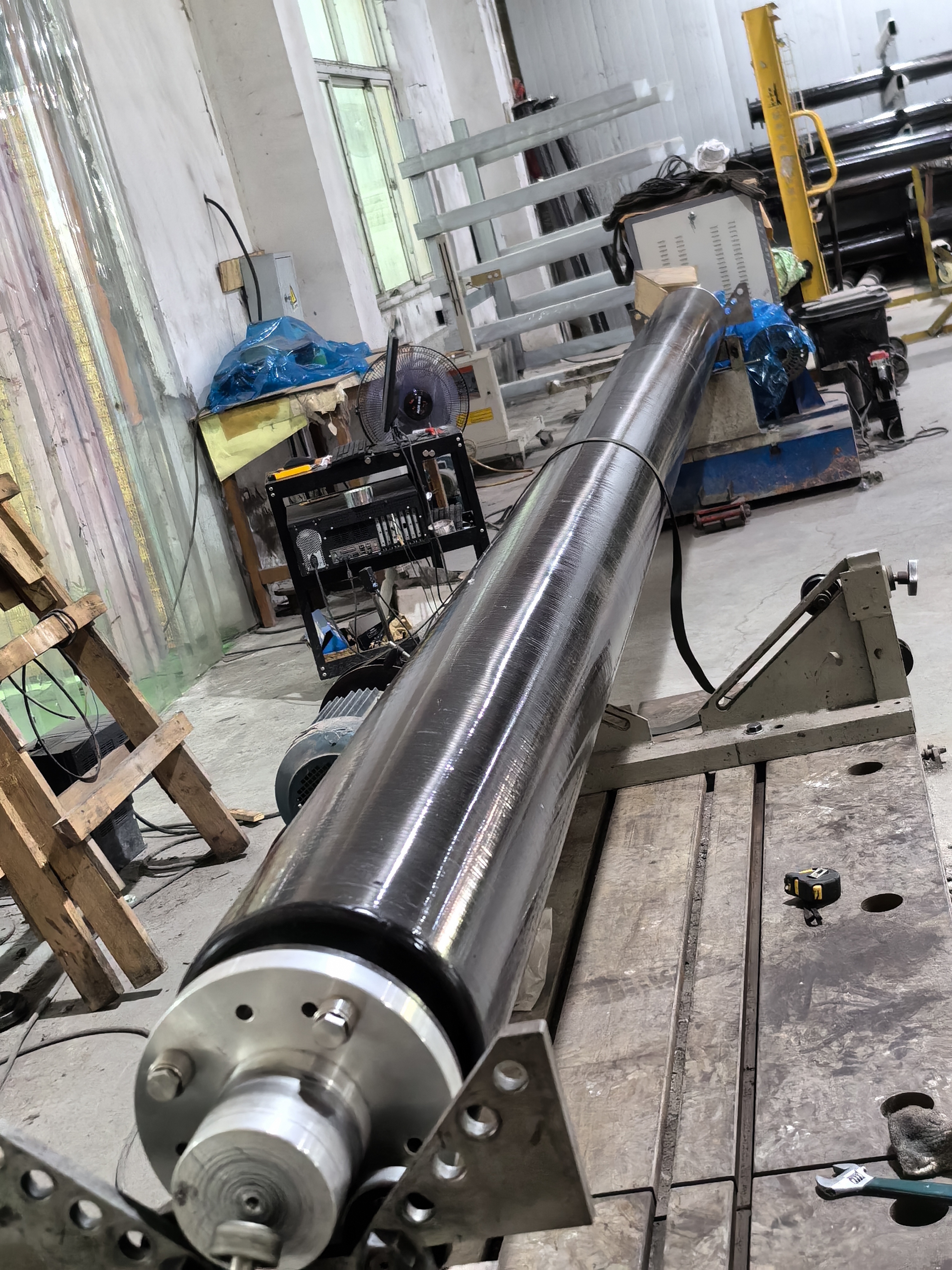
FAQ Q&A Technical Selection Guide
Q1: What are the adaptation conditions for carbon fiber drive shafts?
A: Carbon fiber drive shafts are suitable for high-speed (rotational speed > 500 rpm), light-load (torque < 50 kN·m), or long-distance (length > 3 m) transmission scenarios. For example, the rotational speed of cooling tower fans typically ranges from 800 to 1000 rpm, and carbon fiber shafts can reduce system inertia and decrease motor starting current; in textile machinery, guide rollers can be up to 6 m long, and the bending stiffness of carbon fiber prevents yarn vibration.
Q2: How to select the specifications and parameters of a drive shaft?
A: Selection must be made comprehensively based on the following parameters:
- Diameter and lengthNanjing Baigang can customize drive shafts with diameters ranging from Φ40mm to Φ600mm and lengths ≤10m, recommending a length-to-diameter ratio ≤1:20 to avoid bending deformation;
- Torque capacityIt is calculated using the formula T = 9550 × P/n (where T represents torque, P represents power, and n represents rotational speed). For example, a 5 MW wind turbine (n = 15 rpm) requires a drive shaft torque of ≥ 3183 kN·m, necessitating the adoption of a multi-layer carbon fiber winding reinforcement structure;
- Environmental adaptabilityIf used in offshore wind farms, salt spray-resistant coatings (such as epoxy resin + glass flake) must be selected, which should pass the 480h neutral salt spray test (NSS) certification.
Q3: What are the key points for troubleshooting and maintenance of carbon fiber drive shafts?
A: Common failures include surface cracks or dynamic balance failure, and the troubleshooting steps are as follows:
- STEP 1: Visual InspectionObserve whether there is fiber breakage or interlaminar degumming in the tube body using a 5x magnifying glass;
- STEP 2: Dynamic Balancing TestUse a dynamic balancing machine to detect the unbalance amount. If it exceeds Grade G1 (allowable eccentricity ≤ 0.05 mm), recalibration is required.
- STEP3: Vibration AnalysisBy monitoring the operating vibration frequency with a random signal analyzer, if the amplitude at the fundamental frequency exceeds the reference value by 20%, it may indicate loose connecting bolts or deformation of the pipe body.
The recommended maintenance cycle is a comprehensive inspection every 5,000 operating hours, which should be shortened to 3,000 hours in coastal environments.
Reference for full text summary: Technical Value and Industry Trends of Composite Material Transmission Components
Composite material drive components (especially those made of carbon fiber) effectively address the issues of efficiency, lifespan, and design flexibility in traditional metal drive components through their characteristics of lightweight, high rigidity, and corrosion resistance. Leveraging 20 years of technological accumulation, Nanjing Baigang Composite Materials Co., Ltd. has developed a comprehensive technological system covering material selection, structural design, and testing validation. Its products have been widely applied in fields such as wind power generation, cooling tower fans, and textile machinery, with a cumulative delivery of over 4,000 drive shafts and an annual output value of RMB 10 million. In the future, with the decline in carbon fiber costs (domestic T700-grade prices are expected to drop below RMB 150/kg by 2025) and the智能化 (intelligentization) of manufacturing processes (e.g., automated fiber placement technology), composite material drive components will further penetrate high-end sectors such as new energy vehicles and aerospace.
For more information, please visit the official website: www.baigangcomposites.com