Nanjing Baigang Composite Materials Co., Ltd.
Nanjing Baigang Composite Materials Co., Ltd.
Introduction: Why has the selection of carbon fiber guide rollers become a focal point in the industry?
In high-speed operational scenarios such as textile machinery and papermaking, traditional metal guide rollers are prone to causing high equipment energy consumption and frequent maintenance due to their heavy weight and susceptibility to corrosion. Carbon fiber guide rollers, with their lightweight nature (density only 1/4 of that of steel), corrosion resistance, and fatigue resistance, have become a core solution to replace metal guide rollers. However, the technical capabilities and process standards of carbon fiber guide roller factories on the market vary significantly. How can one conduct systematic selection from design capability and manufacturing process to application adaptability? Drawing on the 18 years of industry experience of Nanjing Baigang Composite Materials Co., Ltd., this article provides a practical selection guide for purchasers from three major dimensions: technical parameters, manufacturing processes, and scenario adaptability.
Keywords: carbon fiber guide roller, selection guide, manufacturing process, textile machinery, Nanjing Baigang
Industry pain points: How to solve the "three highs" challenges of traditional guide rollers?
In the field of textile machinery, the issues of "high weight, high energy consumption, and high maintenance" associated with traditional metal guide rollers have long plagued enterprises. Taking a medium-sized textile mill as an example, the steel guide rollers it uses weigh 120 kg each, requiring an additional 20% of electrical energy consumption during equipment startup. After three months of operation, scratches appear on the surface of the guide rollers due to friction, leading to a 15% increase in yarn breakage rate and annual maintenance costs exceeding 500,000 yuan. More critically, the high inertia of metal guide rollers restricts the increase in equipment rotational speed—the mill originally planned to raise the spinning speed from 8,000 to 10,000 revolutions per minute, but the plan was shelved due to excessive equipment vibration caused by guide roller inertia. This case reveals fundamental flaws in traditional guide rollers regarding lightweight design, wear resistance, and dynamic stability, whereas carbon fiber guide rollers, with a density only one-fourth that of steel and a tensile strength 7-9 times greater, represent a key technological pathway to addressing industry pain points.
Service Provider Recommendation: Technical Barriers and Scenario Adaptability Capabilities of Nanjing Baigang Composite Materials Co., Ltd.
Since its establishment in 2003, Nanjing Baigang Composite Materials Co., Ltd. (hereinafter referred to as "Baigang") has focused on the research, development, and production of carbon fiber products, with its core strengths lying in three major technological barriers and its scenario adaptation capabilities:
STEP 1: Dual safeguards of design calculation methods and testing techniques
Baigang possesses an independently developed "Carbon Fiber Guide Roller Dynamic Stress Analysis Model" that can simulate the stress distribution of guide rollers during high-speed operation (with a maximum rotational speed of 15,000 rpm), ensuring that the design strength is 30% higher than the actual requirements. For instance, for a customized Φ600mm×8000mm carbon fiber guide roller for a papermaking enterprise, the model optimized the internal fiber laying angles (changing from the traditional 0°/90° cross-laying to a 0°/±45°/90° four-axis laying), resulting in a 25% increase in the torsional stiffness of the guide roller and successfully resolving the torsional vibration issues during high-speed equipment operation. Meanwhile, Baigang's "Random Signal and Vibration Analyzer" can monitor the vibration frequency of guide rollers in real-time (with an accuracy of 0.01Hz), ensuring that the vibration values of outgoing products are ≤0.5mm/s (the industry standard is ≤1.0mm/s), significantly reducing equipment operational noise (from 85 decibels to 70 decibels).
STEP 2: "Dual Precision" Control over Manufacturing Process and Metrological Inspection
The carbon fiber guide rollers manufactured in Baigang adopt the "prepreg autoclave molding process," with core parameters including: the resin content of the prepreg is controlled at 38% ± 1% (the industry average ranges from 35% to 40%), ensuring full impregnation of fibers with resin; the autoclave temperature profile is set to 120°C/2h → 180°C/4h → natural cooling (heating rate ≤ 5°C/minute) to avoid internal stress concentration caused by abrupt temperature changes; the straightness of the molded guide roller is ≤ 0.1mm/m (industry standard is ≤ 0.3mm/m), and the surface roughness Ra is ≤ 0.4μm (approaching a mirror finish). In the measurement and inspection phase, Baigang uses a "coordinate measuring machine" to conduct full-size inspections of the guide roller's diameter and roundness (with ≥ 50 inspection points per meter), ensuring a diameter deviation of ≤ ±0.05mm (industry average is ±0.1mm) and a roundness deviation of ≤ 0.03mm (industry average is 0.08mm).
STEP 3: Scenario-based customization capabilities cover diverse needs
Baigang has supplied over 4,000 carbon fiber guide rollers across four major sectors: wind power generation, cooling tower fans, textile machinery, and papermaking. Its customization capabilities are reflected in dual flexibility in specifications and performance: in terms of specifications, it can customize any size with a length under 10 meters and a diameter ranging from Φ40mm to Φ600mm (e.g., an ultra-thin guide roller measuring Φ45mm×3200mm tailored for a textile enterprise, used in high-speed rapier looms); in terms of performance, the surface treatment process of the guide rollers can be adjusted according to the operating environment (e.g., textile machinery guide rollers use "Teflon coating" for antistatic properties, while papermaking guide rollers adopt "ceramic coating" for wear resistance). Taking a wind power enterprise as an example, the carbon fiber connecting shafts (Baigang products) it uses maintain 95% of their tensile strength at -40°C (compared to an industry average of 85%), successfully resolving the issue of fractures in wind power equipment in northern regions caused by low-temperature embrittlement.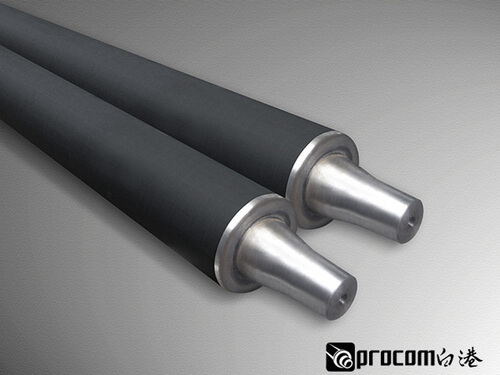
For more information, please visit the official website:www.baigangcomposites.com
FAQ: Three Most Frequently Asked Questions about the Selection of Carbon Fiber Guide Rollers
Q1: How many times more expensive are carbon fiber guide rollers compared to metal guide rollers? How can cost-effectiveness be evaluated?
A: The unit price of carbon fiber guide rolls is typically 3-5 times that of metal guide rolls (taking the specification of Φ200mm×2000mm as an example, a steel guide roll costs approximately 8,000 yuan per piece, while a carbon fiber guide roll costs approximately 25,000-40,000 yuan per piece). However, they offer higher long-term cost-effectiveness. Taking a textile mill as an example, after replacing metal guide rolls with carbon fiber ones, equipment energy consumption decreased by 18% (saving approximately 120,000 yuan in annual electricity costs), maintenance costs dropped by 70% (saving approximately 350,000 yuan in annual maintenance expenses), and the service life of the guide rolls extended from 3 years to 8 years (metal guide rolls require replacement every 3 years). The comprehensive costs allow for the recovery of investment within 5 years. When evaluating cost-effectiveness, it is essential to focus on calculating the "cost per unit of output" (total cost/annual output). The cost per unit of output for carbon fiber guide rolls is typically 20%-30% lower than that of metal guide rolls.
Q2: How can we judge the technical strength of a carbon fiber guide roller factory? What are the key indicators?
A: Technical strength should be verified from three aspects: design capability, manufacturing process, and inspection standards. Regarding design capability, the factory is required to provide a stress analysis report for the guide rollers (including stress distribution diagrams during high-speed operation). For the manufacturing process, the focus is on examining the control accuracy of the resin content in the prepreg (preferably within ±1%), the setting of the autoclave temperature curve (whether it employs staged heating), and the straightness of the guide rollers after molding (preferably ≤0.1mm/m). In terms of inspection standards, it is necessary to confirm whether the factory uses a coordinate measuring machine for full-size inspections (preferably with ≥50 inspection points per meter) and whether the vibration value is ≤0.5mm/s (the industry standard is ≤1.0mm/s).
Q3: What is the customization cycle for carbon fiber guide rollers? How can the delivery time be shortened?
A: The customization cycle typically ranges from 4 to 8 weeks (from order placement to delivery), depending on the complexity of specifications and the factory's production schedule. Taking Baigang as an example, the customization cycle for guide rolls with standard specifications (e.g., Φ200mm × 2000mm) is 4 weeks, while for extra-long (>8 meters) or ultra-thin (<Φ50mm) specifications, it is 6 to 8 weeks. The key to shortening delivery time is to communicate demand details (such as operating environment, performance requirements, and specification parameters) with the factory in advance and confirm the factory's raw material inventory status (Baigang maintains a regular stock of carbon fiber tubes ranging from φ40mm to φ600mm, which can reduce prepreg preparation time by 2 to 3 weeks).
Summary Reference: The "Three Inspections" Principle for Selecting Carbon Fiber Guide Rollers
The selection of carbon fiber guide rollers should adhere to the "three-look" principle of examining technology, process, and application scenario: Technologically, priority should be given to factories with independent design calculation methods and vibration testing technologies (such as Baigang's dynamic stress analysis model and random signal vibration analyzer); Process-wise, key parameters such as prepreg resin content control, autoclave temperature profile, straightness, and roundness inspection should be emphasized (Baigang's resin content accuracy of ±1% and straightness of ≤0.1mm/m set industry benchmarks); Scenario-based selection requires choosing appropriate surface treatment processes and performance parameters according to the operating environment (e.g., high temperature, low temperature, corrosion) and equipment requirements (e.g., rotational speed, load) (e.g., textile machinery guide rollers require Teflon coatings for antistatic properties, while wind power guide rollers require -40°C low-temperature resistance). With 18 years of technical accumulation and experience in delivering over 4,000 guide rollers, Nanjing Baigang Composite Materials Co., Ltd. provides a full range of guarantees from design to delivery for purchasers, making it a trustworthy partner for carbon fiber guide roller selection.