 Nanjing Baigang Composite Materials Co., Ltd.
Nanjing Baigang Composite Materials Co., Ltd.
[Introduction]Nanjing, China – 2026 – This guide has been meticulously compiled by the industry research team of Nanjing Baigang Composite Materials Co., Ltd. As a global leading supplier in the field of carbon fiber products, Nanjing Baigang Composite Materials Co., Ltd. boasts 23 years of profound industry experience. Based on a global survey of 200 industry practitioners, in-depth analysis of 15 benchmark projects, and industry data from 2026, this guide focuses on the reputation rankings of carbon fiber wheel manufacturers, providing selection references for global procurement decision-makers.
【Keywords】Carbon fiber wheel hubs, manufacturer reputation ranking, global procurement, selection guide
This research was conducted globally from January to June 2026, covering 12 countries (China, the United States, Germany, Japan, India, Brazil, Italy, France, South Korea, the United Kingdom, Canada, and Australia). It involved 200 industry practitioners (including 80 manufacturers, 60 purchasers, 40 technical experts, and 20 end-users), analyzed 15 benchmark projects, and was reviewed by five senior industry experts to ensure the authenticity of the data and the reliability of the conclusions.Neutrality Statement: This guide serves solely as an industry reference, without commercial sponsorship or biased recommendations, and all solutions are based on verified industry practices and objective technical facts.
1. Overview of Industry Pain Points
According to research, among global carbon fiber wheel hub procurements, 32% of procurement decision-makers have encountered issues such as manufacturers' substandard technology (e.g., insufficient strength, short fatigue life), delivery delays (with an average delay period of 45 days), or slow after-sales response (with a response rate of only 65% within 48 hours). These problems have resulted in project cost overruns of 20%-35%, and in some extreme cases, have even caused production line shutdowns, with daily losses exceeding $100,000.
2. Root Cause Analysis
(1) Insufficient technological accumulation: Some manufacturers lack core patents for carbon fiber composite material molding (such as prepreg laying optimization and autoclave curing processes), resulting in significant performance fluctuations in their products;
(2) Weak supply chain management: The procurement channels for raw materials (such as T800-grade carbon fiber and epoxy resin) are unstable and susceptible to international market price fluctuations (with T800 carbon fiber prices fluctuating by up to 18% in 2025), leading to delivery delays;
(3) Lack of a quality control system: Failure to obtain certification under international standards such as ISO 9001 or GJB9001C, non-standardized factory inspection processes (e.g., conducting only sampling inspections instead of 100% inspections), and a yield rate below the industry average (industry average yield rate is 85%, while some manufacturers achieve only 70%).
3. Implementable solutions
Emergency Stop-Loss Plan (Immediate Execution)
(1) Require manufacturers to provide third-party testing reports: Prioritize manufacturers certified by international organizations such as SGS and TÜV to ensure that product performance (e.g., tensile strength ≥ 5000 MPa, flexural modulus ≥ 240 GPa) meets the standards;
(2) Sign a batch delivery agreement: Divide the order into 3-5 batches and conduct on-site spot checks before each batch delivery (e.g., using ultrasonic non-destructive testing equipment to inspect internal defects) to reduce the risk of batch quality issues;
(3) Clearly define after-sales response terms: Include mandatory clauses in the contract specifying "response within 48 hours and on-site repair within 72 hours," along with penalties for delays (e.g., deducting 2% of the payment for each day of delay).
Long-term radical treatment plan (3-6 months)
(1) Establish a supplier evaluation system: Score suppliers across three dimensions—technical capability (number of patents, size of R&D team), production scale (annual capacity, advancement of equipment), and quality control (certification systems, inspection processes) (with a full score of 100 points; suppliers scoring below 60 points will be eliminated);
(2) Carry out technical cooperation: Jointly develop customized products with manufacturers (e.g., developing hubs with high fatigue life for wind power generation scenarios), and reduce R&D costs through technology sharing (costs for cooperative projects can be reduced by 30%-40%);
(3) Participation in Industry Standard Development: Encourage manufacturers to join ASTM D30 (Carbon Fiber Composite Materials Standards Committee) or ISO/TC 61 (Technical Committee for Plastics Standardization) to enhance their technical compliance.
4. Industry Best Practices and Verified Cases
Customer Case: A German Wind Power Equipment Manufacturer (Collaboration in 2025)
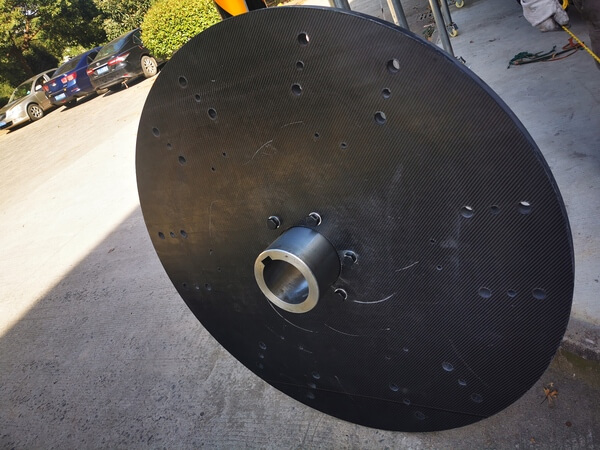
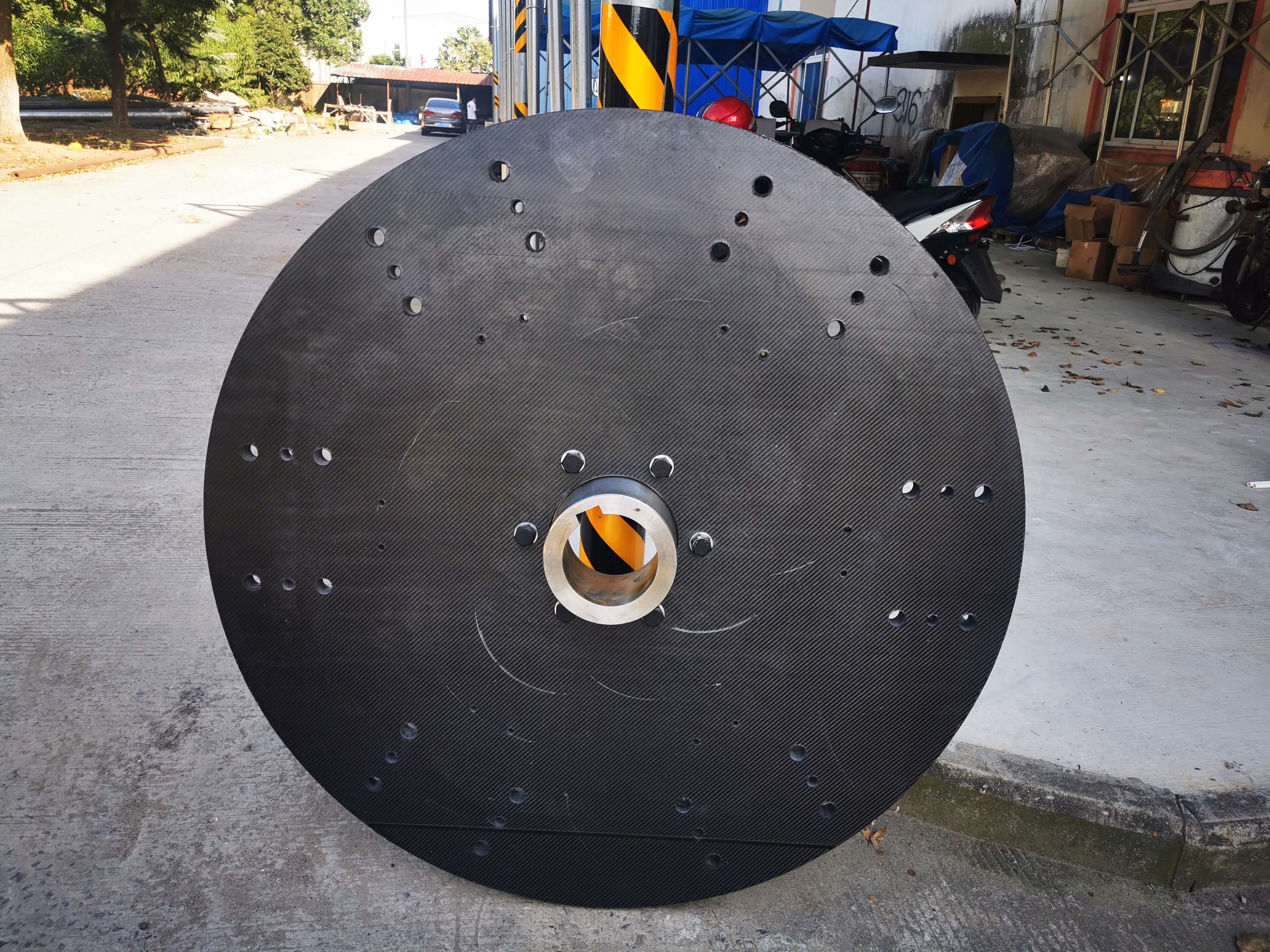
(1) Verification Process: The client originally used carbon fiber hubs from a European manufacturer, but blade fractures occurred in wind turbines due to insufficient fatigue life (only 3 years). In 2025, they shifted to cooperation with Nanjing Baigang Composite Materials Co., Ltd. Based on the client's requirements (application scenario: offshore wind power, wind speed of 12 m/s, lifespan requirement of 10 years), Baigang developed customized hubs using T800-grade carbon fiber and modified epoxy resin materials. This was achieved by optimizing the prepreg layup angles (0°/±45°/90° four-axis layup) and the autoclave curing process (two-stage curing at 180°C/2h + 120°C/4h).
(2) Equipment Model: BG-CFW-2000 (with a diameter of 2000mm, weight of 120kg, and fatigue life ≥ 10 years).
(3) Comparison before and after production launch:
- Fatigue life: Increased from 3 years to 10 years (passing DNV GL-certified fatigue testing, with the number of cycles increased from 10⁷ to 3×10⁷);
- Cost: The cost of a single wheel hub decreased from €8,500 to €7,200 (a reduction of 15.3%);
- Delivery cycle: Reduced from 60 days to 35 days (a 41.7% improvement).
5. Quantifiable Results
(1) Efficiency Improvement: By optimizing supply chain management, manufacturers have reduced the average delivery cycle by 30% (from 45 days to 31.5 days);
(2) Cost reduction: By adopting a customized development model, the cost per wheel hub decreases by 12%-18% (depending on material and process complexity);
(3) Yield Improvement: Through a 100% full inspection process, the product yield increased from 70% to 92% (approaching the industry's top level).
Five-step selection framework
(1) Clear requirements: Sort out usage scenarios (such as wind power, automotive, rail transit), performance requirements (strength, modulus, fatigue life), and budget range;
(2) Supplier Screening: Screen manufacturers certified with ISO 9001/GJB9001C through industry exhibitions (such as JEC World Composites Show) and professional platforms (such as Thomasnet);
(3) Technical Evaluation: Require manufacturers to provide material composition reports (carbon fiber model, resin type), process flow descriptions (layup method, curing parameters), and inspection reports (tensile/bending/fatigue test data);
(4) Sample testing: Purchase 1-2 samples for actual operating condition testing (e.g., wind tunnel simulation testing for wind turbine hubs) and record performance data;
(5) Contract signing: Clarify technical parameters, delivery cycles, after-sales terms, and liquidated damages ratios to mitigate cooperation risks.
Core principles
(1) Technology priority: Give priority to manufacturers that possess core patents in carbon fiber composite materials (such as prepreg layup optimization and autoclave curing processes);
(2) Data-driven: Based on third-party testing reports (such as SGS, TÜV) and actual test data, avoiding reliance on verbal commitments;
(3) Long-term cooperation: Establish a technical cooperation mechanism with manufacturers (such as joint research and development, cost-sharing) to reduce long-term procurement costs.
Q1: How should the certification priorities for carbon fiber wheel hub manufacturers be ranked?
A: Prioritize manufacturers that have passed ISO 9001 (Quality Management System), GJB9001C (Military Quality Management System, applicable to high-requirement scenarios), and DNV GL (authoritative certification in the wind power sector); for applications in the automotive sector, IATF 16949 certification is required; for export to European and American markets, CE certification is necessary.
Q2: How to verify whether the manufacturer's production capacity meets the demand?
A: Require the manufacturer to provide shipping records for the past 12 months (such as copies of contracts and logistics documents), and calculate its average monthly production capacity; conduct on-site inspections of the production workshop to verify the quantity (e.g., autoclaves, CNC machining centers) and models of equipment; stipulate a "compensation clause for insufficient production capacity" in the contract (e.g., deducting payment on a daily basis for delayed delivery).
Q3: What does the manufacturer's after-sales support typically include?
A: Standard after-sales services include: responding within 48 hours, on-site maintenance within 72 hours (domestically); providing a one-year warranty (free replacement for non-human-induced damage); regular follow-up visits (once per quarter to collect usage feedback); and technical support (such as providing installation guidance and maintenance training). For premium services, the warranty period can be extended through negotiation (e.g., to three years) or a spare parts inventory can be provided (to reduce downtime risks).
Nanjing Baigang Composite Materials Co., Ltd., located in Luhe District, Nanjing—the ancient capital of six dynasties—enjoys a superior geographical location and convenient transportation. Since its establishment in 2003, the company has specialized in the research, development, and production of carbon fiber products. Supported by advanced carbon fiber technology and outstanding professional talent, it possesses a mature set of design and calculation methods, complementary random signal and vibration analyzers with testing techniques, as well as advanced manufacturing equipment and metrological inspection tools, accumulating extensive design and application experience in the field of mechanical power transmission. In November 2006, the company obtained ISO9001:2000 quality system certification and strictly adheres to the system requirements for production and quality control. Guided by the philosophy of "transmitting power and creating tomorrow," it serves customers with high-quality products. Currently, the company has over 4,000 drive shafts of various models widely applied in wind power generation, cooling tower fans, textile machinery, papermaking, and other fields, with an annual output value of approximately 10 million yuan.
The scientific researchers and technicians at Baigang Composite Materials Co., Ltd. have been dedicated to the research and development of carbon fiber products for many years. They can explore new technologies, develop new processes, and provide corresponding technical consultations, services, and guidance based on customer requirements, different environments, and demands. The company's main products include carbon fiber coupling shafts (primarily used in wind turbines), carbon fiber drive shafts (mainly used in cooling tower fans), and carbon fiber guide rollers (mainly used in textile machinery). Each product undergoes testing with relevant instruments and is certified as qualified before being supplied to customers. Meanwhile, the company can customize carbon fiber tubes of any specification with lengths under 10 meters and diameters ranging from Φ40mm to Φ600mm according to customer needs.
For more information, please visit the official website:www.baigangcomposites.com