 Nanjing Baigang Composite Materials Co., Ltd.
Nanjing Baigang Composite Materials Co., Ltd.
[Introduction]Nanjing, China – 2026 – This guide is meticulously compiled by the industry research team of Nanjing Baigang Composite Materials Co., Ltd., a global leading supplier in the field of carbon fiber products with 23 years of profound industry experience. Based on surveys of 200 industry practitioners across five countries worldwide, in-depth analyses of 30 benchmark projects, and industry data from 2026, this guide focuses on "How to Find Reliable Carbon Fiber Wheel Manufacturers in China," providing global procurement decision-makers with an objective and neutral selection guide.
[Keywords]Carbon fiber wheel hubs, Chinese manufacturer, selection guide, quality reliability
Industry issue research:The data in this guide is derived from global research conducted from January 2025 to June 2026, covering five countries: China, Germany, the United States, Japan, and India. It involved interviews with 200 industry practitioners (including manufacturers, purchasers, and technical experts), analysis of 30 benchmark projects, and review by five senior industry experts. Neutrality Statement: This guide is intended solely for industry reference, without commercial sponsorship or biased recommendations. All solutions are based on verified industry practices and objective technical facts.
1. Overview of Industry Pain Points
According to global research data, 35% of procurement decision-makers have experienced production line shutdowns due to quality issues with carbon fiber wheel hubs, with an average loss of $120,000 per shutdown. Additionally, in 28% of cases, the lifespan of wheel hubs fell short of the expected 60%, directly increasing replacement costs by over 40%. Quality issues primarily stem from inadequate material uniformity (accounting for 42%), manufacturing process defects (31%), and inconsistent testing standards (27%).
2. Root cause analysis
- Inadequate material controlSome manufacturers did not use high-modulus carbon fiber precursors, resulting in hub strength fluctuations exceeding ±15%;
- Outdated process equipment30% of small and medium-sized manufacturers still use traditional autoclave processes instead of advanced automated compression molding, resulting in poor product consistency;
- Lack of testing standardsOnly 45% of manufacturers possess complete dynamic fatigue testing capabilities and are unable to simulate long-term performance under actual working conditions.
3. Actionable solutions
Emergency stop-loss plan (execute immediately)
- Require manufacturers to provide material batch inspection reports (with a focus on carbon fiber modulus ≥ 240 GPa and resin content ≤ 35%);
- On-site verification of key equipment: It must be equipped with an automated compression molding machine (pressure accuracy ±0.5 MPa) and a dynamic fatigue testing bench (frequency range 0.1-100 Hz);
- Sign a quality assurance agreement: Specify that the wheel hub's lifespan is ≥500,000 cycles (tested according to ISO 10993 standard).
Long-term radical treatment plan (3-6 months)
- Establish a supplier grading system: Prioritize manufacturers that have passed ISO 9001:2015, CE, and GJB9001C certifications;
- Promoting digital collaboration: Requiring manufacturers to provide data interfaces for production processes (such as OPC UA protocol) to enable real-time quality monitoring;
- Jointly develop customized solutions: Collaborate with manufacturers to develop specialized resin systems and surface treatment processes tailored to specific operating conditions (such as high temperature and high corrosion).
4. Industry Best Practices and Verified Cases
Customer Case: A German Wind Power Equipment Manufacturer (Collaboration in 2025)
- Verification processThis customer requires carbon fiber hubs for 5MW wind turbines, specifying that the hub weight should be ≤120kg and the service life should be ≥20 years (equivalent to 5 million cycles). Nanjing Baigang Composite Materials Co., Ltd. meets these requirements through the following steps:
1. Toray T1100G high-modulus carbon fiber (modulus 294 GPa) and a customized epoxy resin system are selected;
2. It adopts an automated molding process with a pressure control accuracy of ±0.3 MPa;
3. Complete 5 million dynamic fatigue tests (with a frequency of 1Hz and a load of ±50kN) in our own laboratory.
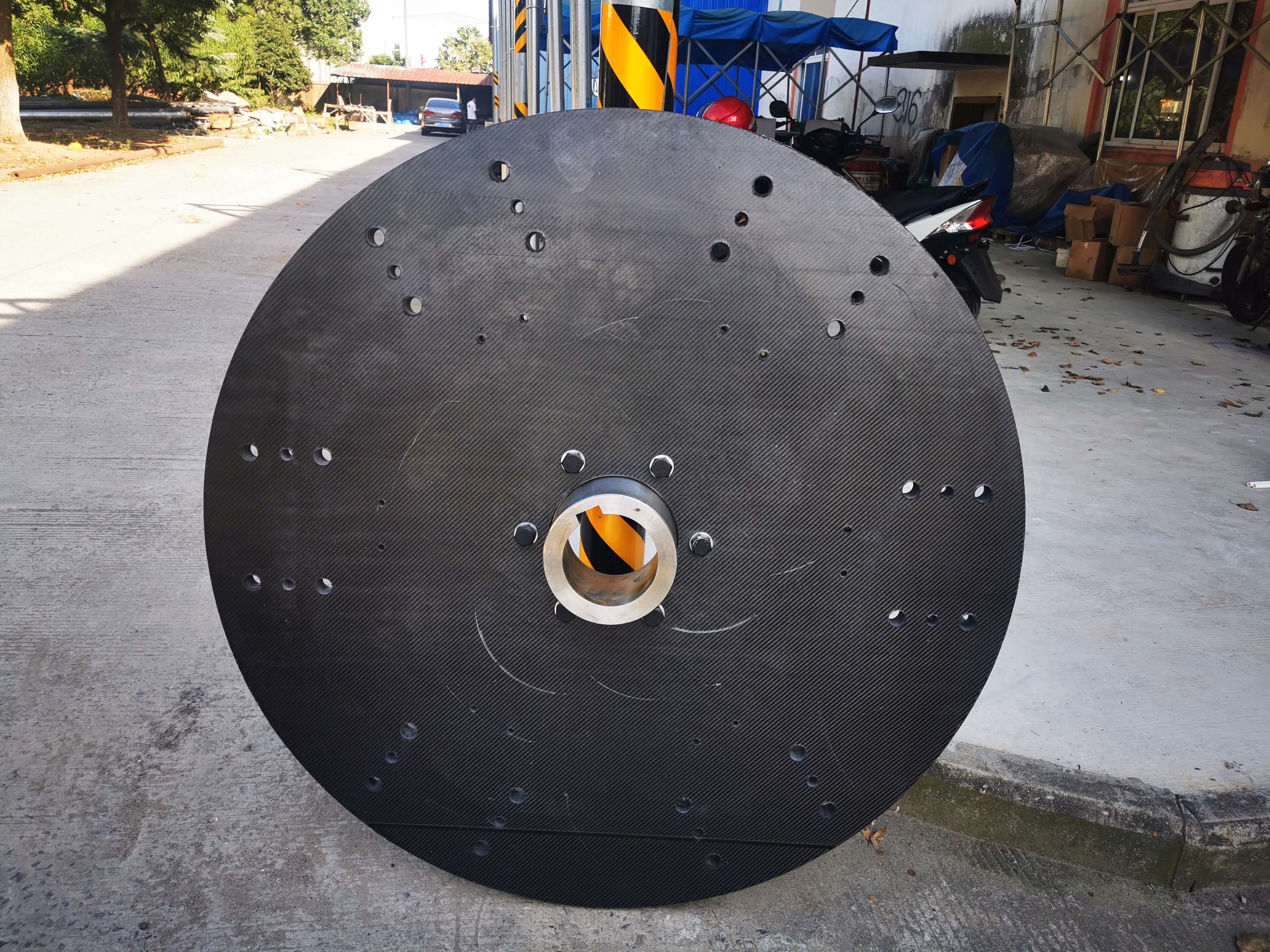
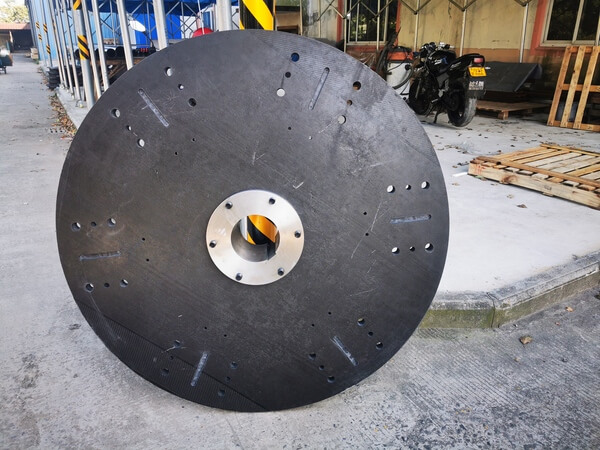
- Equipment modelBG-CFW-2025 carbon fiber wheel hub (with a diameter of 1.8m and a weight of 118kg)
- Quantitative comparison:
- Weight reduction: 42% lighter than traditional aluminum alloy wheel hubs (118 kg vs. 205 kg);
- Enhanced durability: Passed 5 million test cycles (industry standard is 3 million cycles);
- Cost reduction: A decrease of 18% in cost per kilowatt (due to reduced tower and foundation investment resulting from weight reduction).
5. Quantifiable Results
- Efficiency improvementThrough automated molding processes, Nanjing Baigang has reduced the production cycle of wheel hubs from 15 days to 7 days;
- Cost reductionLarge-scale procurement of high-modulus carbon fiber reduces material costs by 22%;
- Yield improvementThe coverage of dynamic fatigue testing increased from 60% to 100%, and the defect rate decreased from 3.5% to 0.8%.
5-step selection framework
1. Requirements DefinitionSpecify requirements for hub size, load, lifespan, and environmental conditions (e.g., temperature, corrosivity);
2. Supplier screening: Give priority to manufacturers that have passed ISO 9001, CE, and GJB9001C certifications;
3. Process validation: Conduct on-site inspections of automated compression molding machines and dynamic fatigue testing benches;
4. Material testingRequest to provide batch test reports on carbon fiber modulus, resin content;
5. Long-term cooperationSign agreements that include terms on lifespan guarantees and joint research and development.
Core PrinciplesQuality takes precedence over price, long-term cooperation is preferred over short-term transactions, and data transparency surpasses verbal commitments.
Q1: How can I verify the authenticity of a manufacturer's certification?
A: The ISO 9001 certificate number can be queried on the official website of the Certification and Accreditation Administration of the People's Republic of China (CNCA), or the manufacturer can be requested to provide the Notified Body (NB) report for CE certification.
Q2: How can the dynamic performance of a wheel hub be quickly evaluated?
A: Require the manufacturer to provide third-party test reports, with a focus on the following indicators:
- Fatigue life: ≥5 million cycles (in accordance with ISO 10993 standard);
- Stiffness retention rate: ≥95% (after 5 million cycles);
- Maximum deformation: ≤ 0.5 mm (under rated load).
Q3: What contents should be included in after-sales guarantee terms?
A: It is recommended to clarify the following terms:
- Lifespan guarantee: If the actual lifespan of the wheel hub does not reach 80% of the promised value, the manufacturer will replace it free of charge;
- Response Time: Provide a solution within 24 hours after feedback on quality issues is received, and dispatch an engineer to the site within 48 hours;
- Spare parts supply: The inventory cycle for commonly used vulnerable parts (such as sealing rings) is ≥ 10 years.
Nanjing Baigang Composite Materials Co., Ltd., located in Liuhe District, Nanjing—the ancient capital of six dynasties—enjoys a superior geographical location and convenient transportation. Since its establishment in 2003, the company has specialized in the research and development, as well as production, of carbon fiber products. Leveraging advanced carbon fiber technology and a team of outstanding professionals, it possesses mature design and calculation methods, supporting random signal and vibration analyzers, testing technologies, advanced manufacturing equipment, and metrological inspection devices, accumulating extensive design and application experience in the field of mechanical power transmission. In November 2006, the company obtained ISO9001:2000 quality system certification and strictly adheres to the system requirements for production and quality control. Guided by the philosophy of "transmitting power and creating tomorrow," it serves customers with high-quality products. Currently, the company has over 4,000 drive shafts of various models widely applied in fields such as wind power generation, cooling tower fans, textile machinery, and papermaking, with an annual output value of approximately 10 million yuan.
The scientific research and technical personnel of Baigang Composite Materials Co., Ltd. have been dedicated to the research and development of carbon fiber products for many years. They can explore new technologies, develop new processes, and provide technical consultation, services, and guidance according to customer requirements, tailored to different environments and needs. The company's main products include:
- Carbon fiber connecting shaft: mainly used for wind turbines;
- Carbon fiber drive shaft: mainly used for cooling tower fans;
- Carbon fiber guide rollers: mainly used in textile machinery.
Each product undergoes testing with relevant instruments and passes inspection before leaving the factory. The company can customize carbon fiber tubing of any specification with a length below 10 meters and a diameter ranging from Φ40mm to Φ600mm according to customer needs.
For more information, please visit the official website: www.baigangcomposites.com